




Posted by Andreas Vavelidis
on August 06, 2026

A sample service for agency client presentations combines physical samples with realistic 3D visualisations of custom glass trophies and awards. The practical rule is simple: 3D visuals are usually sufficient for early approvals and design iterations, while a physical sample can be valuable for a final decision-maker presentation. The strongest approach combines both.
After reading this guide, you will have:
- A checklist you can send to the manufacturer
- Realistic guidance on timing and cost factors
- A clear proofing workflow
- Criteria for choosing a sample-service partner in Germany
Contents
- What does a sample package include?
- Why physical samples influence presentations
- When is a 3D visual enough, and when do you need a physical sample?
- Timing and costs: what to allow for
- Which glass and engraving method suit your presentation?
- Packaging, shipping and handover
- Proofing workflow: from 3D preview to final approval
- Sample-package checklist
- Why inCrystal is suitable for agency projects
- Key takeaways
- What a good sample package changes
- Request a sample from inCrystal
- Useful resources
What does a sample package include?
A sample package can combine physical pieces and digital approval assets. The exact scope should always be agreed for the individual project.
Possible physical components:
- An individually produced engraved glass trophy
- A small prototype or base option
- A presentation box with a fitted insert
- A product sheet with dimensions and material details
Possible digital assets:
- Realistic 3D views of the proposed award
- An engraving proof as a PDF or PNG
- Optional: a 3D animation for a moving presentation asset
Care instructions, labelling suggestions and return arrangements depend on the provider and project. A custom-made promotional item offers more room for coordination than catalogue merchandise.
Why physical samples influence presentations
Touch, weight and material appearance influence purchasing decisions in ways that even a strong rendering cannot reproduce completely. Holding a glass award makes its quality immediately tangible.
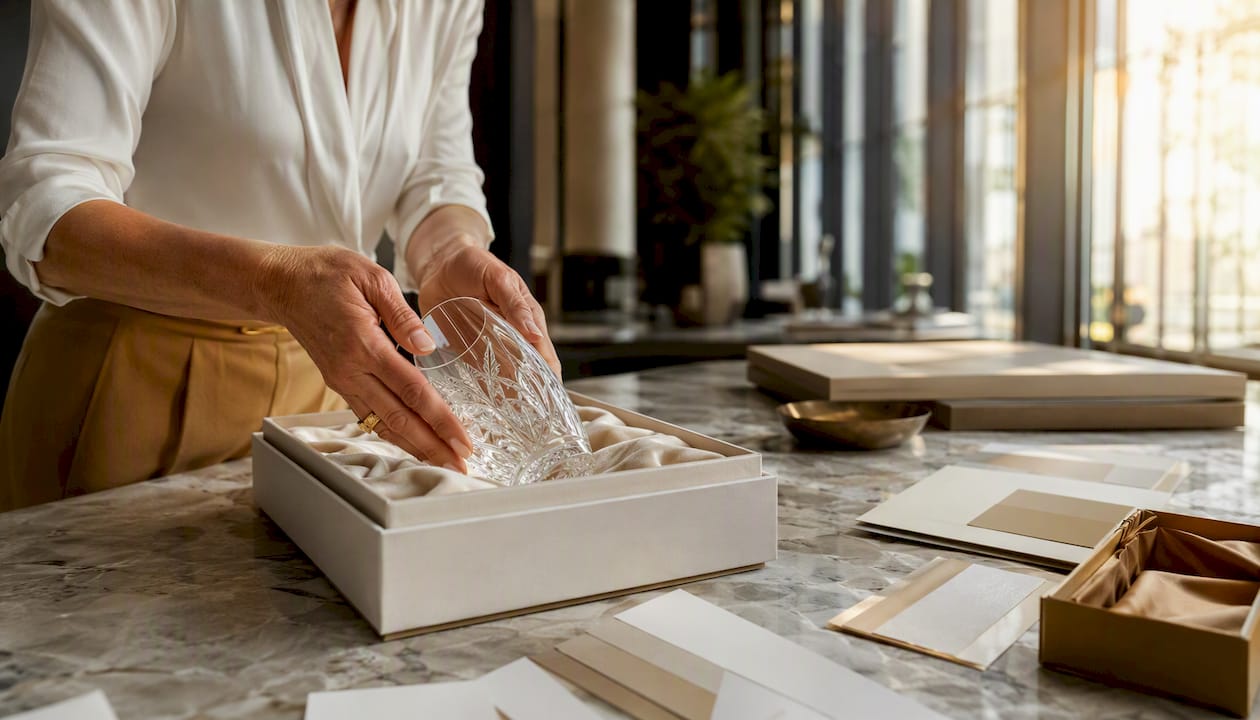
A physical sample is particularly helpful for executive pitches, premium projects and showcase presentations. Glass gifts in client relationships can remain visible in an office long after printed material has been discarded.
Professional tip: Bring the sample in its presentation box. The packaging is part of the first impression.
When is a 3D visual enough, and when do you need a physical sample?
Base the decision on five factors:
- Approval stage: A 3D visual is usually suitable for an early concept approval; a physical sample can support a final board-level decision.
- Presentation format: A rendering works well in a virtual meeting. For an in-person meeting, a sample adds a tactile experience.
- Budget: Physical one-off samples incur production costs. With a limited budget, approve the visual concept first.
- Schedule: If the meeting is imminent, use a 3D visual and confirm whether a physical sample can be produced in time.
- Complexity: Standard shapes are easier to assess digitally. Special shapes, base combinations and unusual engravings may justify a physical check.
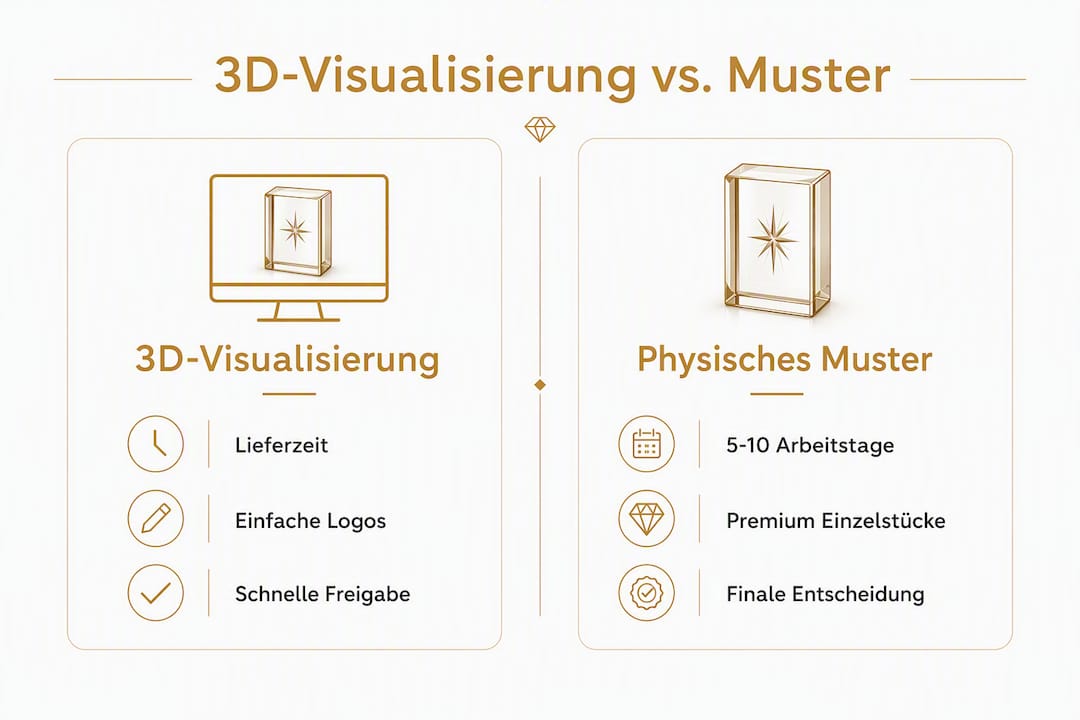
| Criterion | 3D visualisation | Physical sample |
|---|---|---|
| Lead time | Usually shorter; confirm for the project | Requires production and shipping time |
| Cost | A layout preview may be included | Individual sample costs apply |
| Design assessment | Strong visual representation, without touch or weight | Includes material, weight and surface appearance |
| Presentation | Suitable for virtual and in-person meetings | Most useful in person |
| Iterations | Changes can be evaluated quickly | Changes may require a new sample |
| Express options | Subject to scope and availability | Subject to production capacity and shipping |
For a standard award with a simple logo, a 3D proof may be sufficient before production. For a premium piece with special engraving, a physical sample can reduce uncertainty.
Timing and costs: what to allow for
Lead times depend on design complexity, material availability, approval speed, quantity and shipping destination. Ask for a project-specific schedule instead of treating general examples as a binding delivery promise.
Main cost factors:
- A 3D layout preview; complex modelling of an individual object is calculated separately
- Material choice: optical glass or K9 glass is used for premium presentations
- Engraving complexity: a simple logo differs from a detailed three-dimensional motif
- Packaging: a standard carton differs from a branded presentation box
- Shipping, insurance and possible return transport
Express surcharges vary by workload and destination. For projects with several variants, request one complete quotation that lists visualisation, sampling, packaging and shipping separately.
Professional tip: Use the free 3D preview as an approval gate. Commission a paid physical sample only after the visual direction has been approved.
Which glass and engraving method suit your presentation?
The material and engraving method directly affect how the award looks in a client meeting.
Glass types:
- Float glass: More economical, but its edges often show a green tint that can reduce the clarity of internal engraving.
- Optical glass or K9 glass: Clear, substantial and well suited to illuminated awards and premium presentations.
- Crystal glass: Known for strong light refraction and a high-quality appearance; the exact composition varies by product.
Engraving methods:
- 3D laser engraving inside the glass: Creates a durable motif within the glass without marking the surface. It is suitable for logos, portraits and three-dimensional objects.
- Surface engraving: Marks the outside of the glass and produces a different, flatter effect.
- Sandblasting: Creates a classic frosted surface for lettering and simpler designs.
Sample quality checklist:
- Clarity of the glass and absence of distracting inclusions
- Edge colour and overall optical appearance
- Sharpness and position of the engraving
- Fit between the glass and its base
- Clean surfaces without scratches or streaks
For premium presentations, 3D laser engraving inside optical glass provides strong depth and clarity.
Packaging, shipping and handover
Packaging is part of the presentation. A fitted insert protects the award, while a well-designed box signals care before the product is even revealed.
For shipping:
- Agree tracked and appropriately insured shipping
- Clarify return arrangements before dispatch
- Include care and handling information where useful
- Keep the original packaging available for any return shipment
At the meeting:
- Unpack the sample at the intended presentation moment
- Use direct lighting so the internal engraving is clearly visible
- Let decision-makers hold and examine the sample
Professional tip: Photograph the sample in its presentation box after the meeting. The image can support follow-up emails, quotations and internal approvals.
Proofing workflow: from 3D preview to final approval
A clear approval process reduces the risk of expensive remakes.
- 3D preview: Approve the shape, material direction and basic design. Digital changes are easiest at this stage.
- Engraving proof: Check all text, logo placement and source files. Review sizes, spacing and any serial numbers.
- Physical sample: If required, assess weight, surface finish, engraving and base fit before series production.
Communication rules:
- Define a feedback deadline for every approval stage
- Agree how many revision rounds the quotation includes
- Name the responsible contact on both the client and agency sides
- Clarify file formats in advance, preferably vector files such as AI, EPS or SVG
Many common promotional-product mistakes occur during artwork approval. A structured proofing process closes that gap.
Sample-package checklist
Essential information for the manufacturer:
- Contact name, telephone number and email address
- Delivery address and presentation date
- Preferred product, dimensions and glass type
- Logo or engraving files, ideally in a vector format
- The latest date by which the sample or visualisation is required
Optional information:
- Packaging preference: standard carton or presentation box
- Base preference: wood, metal or acrylic
- Lighting or other accessories
- Whether the sample should be returned or remain with the client
Useful file-name convention:
[Project]_[Product]_[Version]_[Date]
Example: AgencySample_K9_v2_2026-03-15
Why inCrystal is suitable for agency projects
inCrystal has many years of experience producing custom glass trophies and awards for agencies and corporate clients. Engraving and final production take place in Germany.
Services include:
- A free 3D layout preview before ordering
- In-house 3D laser engraving
- Engraving and final production in Germany
- Project-specific express options, subject to availability
- Personal project support
- Individual quantities, including one-off pieces
Professional tip: Send the vector logo and required delivery date together. This allows inCrystal to assess the design and schedule in one step.
A structured sample process can strengthen client relationships with personalised glass awards and improve the quality of approval discussions.
Key takeaways
| Topic | Recommendation |
|---|---|
| Best combination | Use a 3D preview for early approvals and a physical sample when touch, weight or a special finish matters. |
| Material | Choose the glass for the project; optical glass or K9 glass is particularly suitable for premium presentations. |
| Scheduling | Request a project-specific lead time and allow time for feedback, production and shipping. |
| Approval gate | Approve the visual direction before commissioning a paid physical sample. |
| inCrystal | Free 3D layout preview, production in Germany, personal support and project-specific quantities. |
What a good sample package changes
A poorly prepared sample creates unnecessary work: the wrong artwork format, unsuitable packaging or a delivery that misses the meeting. These details influence whether the client perceives the entire proposal as professional.
The moment a decision-maker holds the sample cannot be recreated digitally. Everything leading up to that moment can be streamlined with a clear 3D approval process. Agencies that plan the physical sample early, use the visual as an approval gate and present the award in suitable packaging reduce avoidable uncertainty.
After the meeting, photograph the award in its box under good lighting. The resulting image is useful for follow-up communication, quotation documents and internal approval.
Request a sample from inCrystal
Agency projects at inCrystal can start with a free, non-binding 3D layout preview. Physical samples and prototypes are quoted and charged according to the project.
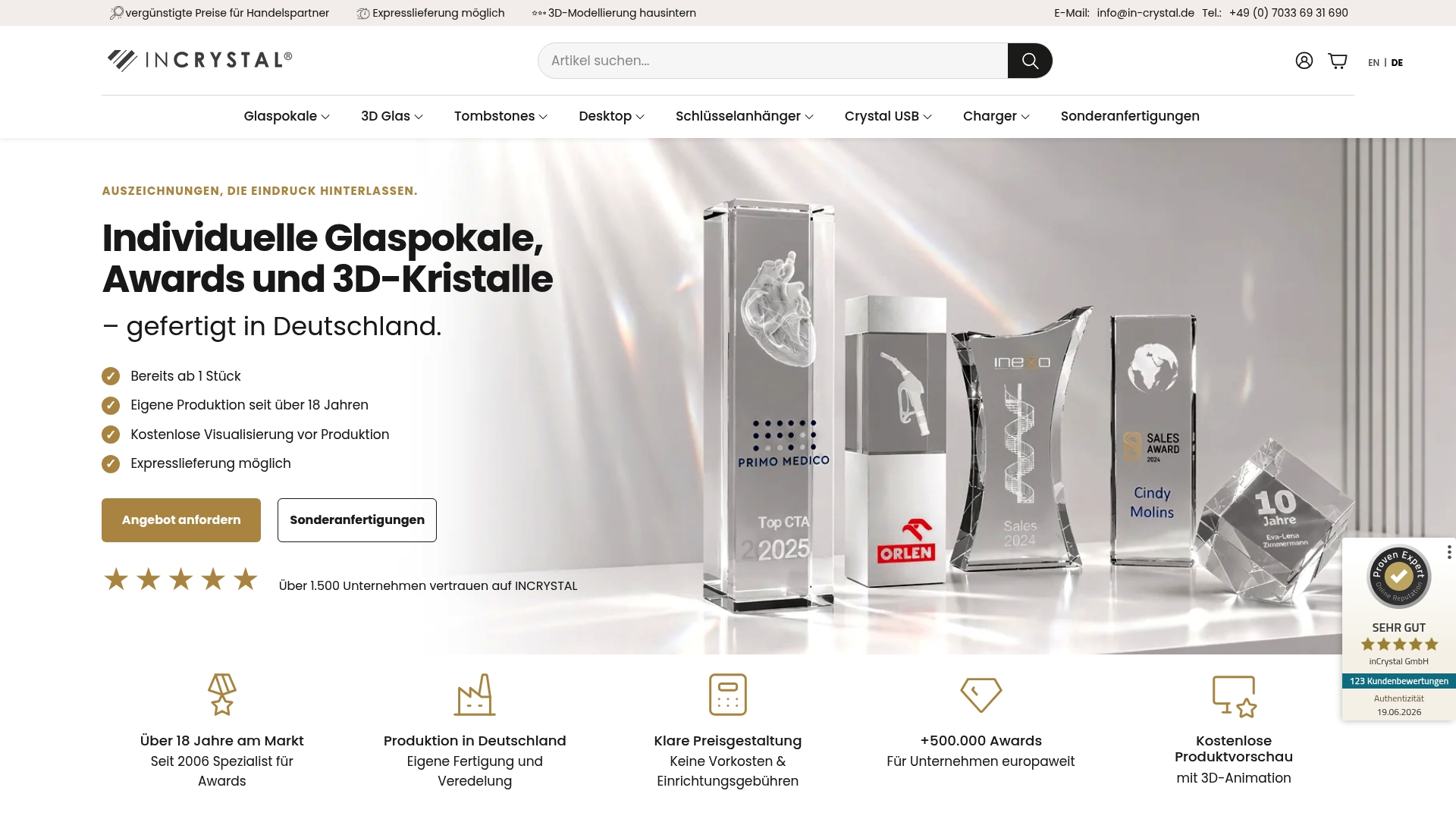
Send the vector logo, preferred award, dimensions, quantity and required delivery date. After the design has been reviewed and approved, a physical sample can be produced if needed. Express options depend on the product, workload and destination.
Explore custom glass trophies and awards or request a free 3D preview.
Useful resources
- 3D laser engraving inside glass
- Request a free 3D preview and quotation
- Designing trophies with a corporate message