




Posted by Andreas Vavelidis
on July 15, 2026

Adjusting glass objects in corporate design means permanently writing brand messages into a high-quality material that clearly exceeds generic promotional products. Anyone who Glass objects as a branded agent, communicates quality and durability in a way that paper or plastic cannot afford. It is not just aesthetics. The choice of decoration technique, the file format of the template and the coordination with the production decide whether the result really fits the corporate design. This guide shows which technical requirements apply, what design options exist and what the way from the idea to the finished glass object looks like.
What technical requirements do you need to adapt glass objects?
Vector files in the formats AI, EPS or PDF are the industry standard for precise engravings and individual shapes for glass objects. Raster images such as JPG or PNG are not enough because they lose sharpness when scaling. Engraving and sculpted graphics tools are made directly from vector data.
- File format: AI, EPS or PDF, at least version Illustrator CS3 or later
- Resolution on bitmap elements: minimum 1,200 dpi for original size
- Color mode: CMYK for screen printing, greyscale or black and white for laser engraving
- Writings: convert to paths so that no fonts are missing
- Logo area: clearly defined protection zone around the trademark
Submitting technically correct vector files accelerates production and ensures the precision of the glass objects. Anyone who delivers faulty files, risks delays of several weeks.
Professional tip: Have your logo transferred to a clean vector format by a digital marketing agency before commissioning. Agencies such as those listed in the overview for Pforzheim know exactly the technical requirements of professional pavers.
In addition to the file format, the production process plays a role. Laser engraving, screen printing and high-temperature baking processes place different requirements on file depth and coloring. Anyone who clarifies this in advance, saves correction loops.
What are the customization options for glass objects in corporate design?
Glass objects offer far more creative freedom than most marketing managers expect. The range ranges from the individual glass shape to the 3D subsurface engraving, which makes motifs visible three-dimensionally in the interior of the material.
Decorative techniques in comparison
| Technology | Optics | Durability | Quantity suitability |
|---|---|---|---|
| Laser engraving | Matted, colourless, noble | Permanently | Small and large editions |
| Screen printing | Coloured, flat | Good at high temperature | Large quantities |
| High-temperature sticker | Coloured, detailed | Dishwasher safe | Medium requirements |
| 3D subsurface engraving | Spatial, transparent | Permanently | Small to medium editions |
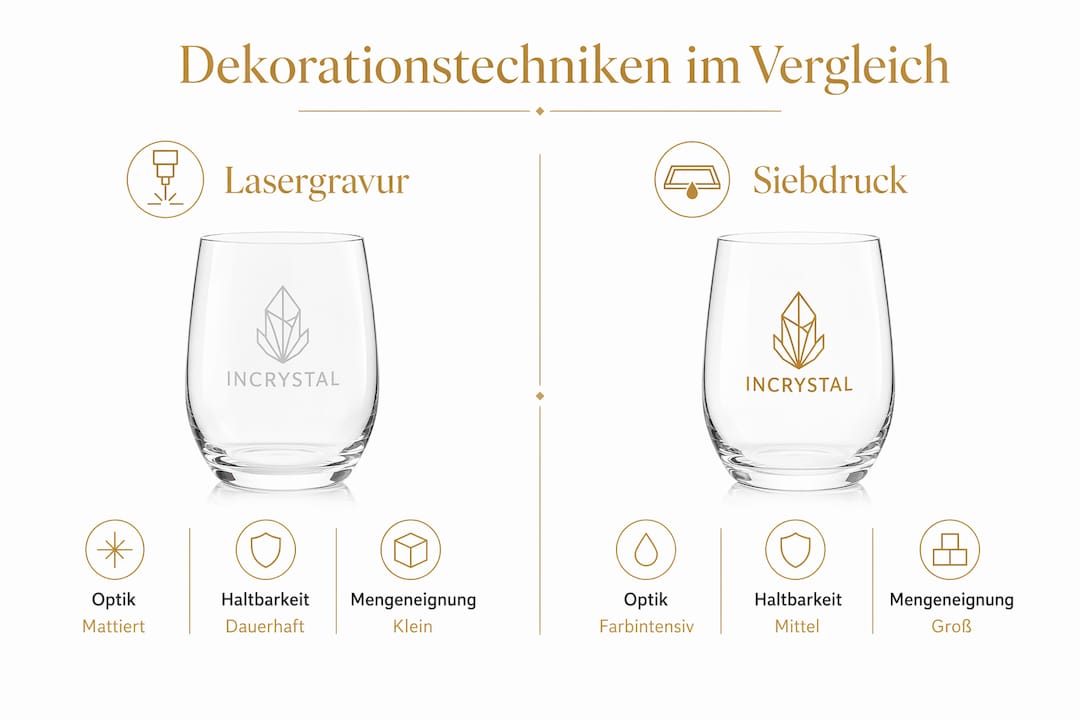
Laser engraving produces a durable, colourless matted look and is particularly suitable for luxury products and premium awards. Screen printing is more cost-effective at large quantities, but is limited to simple color areas. High-temperature baking processes for logos are considered to be the most durable and dishwasher-safe method, which is relevant for everyday advertising gifts.
Further design options:
- Individual glass moulds: Own silhouettes as a brand identifier, for example as a trophy in corporate form
- Surface finishes: Matting, metallic varnishes, sand radiation
- Glass clarity: Clear glass, smoked glass, frosted glass depending on brand effect
- Colors: CI-compliant shades by screen printing or stoving technology
The 3D glass engraving with own logo is a technique that inCrystal has been using for over 18 years. It enables spatial brand motifs in the interior of the glass, which are visible from the outside and do not touch a surface.
How does the process proceed from the idea to the finished glass object?
The path from the design concept to the finished glass object follows a clear sequence. Anyone who knows him avoids the most frequent delays.
- Briefing and design concept: Recording goals, target group, occasion and CI requirements in writing. Logo versions, colors (Pantone or CMYK) and fonts.
- Digital 3D Visualization: Digital 3D design tools allow realistic simulations of glass materials before production begins. inCrystal offers a free 3D preview for this.
- Release of the pattern: Check pre-production samples and release them in writing. Correct deviations in color or engraving depth now, not after series production.
- Quality inspection: Engraving sharpness, color accuracy and dimensional accuracy control.
- Series production and logistics: Delivery times and packaging requirements coordinate early.
Professional tip: Schedule at least 3 months lead time for completely individual glass shapes. Custom glass moulds require lead times of 3 to 6 months, while hybrid solutions with standard glass and individual decor are often available in a few weeks.
Production times and minimum quantities at a glance
| Approach | Lead time | Minimum quantity |
|---|---|---|
| Individual glass mold | 3–6 months | High |
| Hybrid solution (standard glass + decor) | 2–6 weeks | Low to medium |
| Standard glass with laser engraving | 1–3 weeks | Very low |
Hybrid solutions combine standard containers with individual finishes and enable faster market introduction for smaller quantities. For companies that need glass objects for an event at short notice, this is often the only realistic way.
What are the faults typical of the adaptation of glass objects?
Errors in the design of glass objects almost always occur in the same places. The good news is that they are avoidable if you know them.
- Lead time underestimated: Those who order individual glass moulds for a trade fair in March and only start in January have a problem. Three to six months of planning is mandatory.
- Incorrect file format: Logos submitted as JPG or PNG lead to blurred engravings. Only vector data provides tool-accurate results.
- Logo incorrectly placed: Too close to the edge, too large for the engraving area or without a protection zone. Every manufacturer sets placement guidelines. These belong in the briefing.
- CI colors not tuned: Pantone colors must be tested separately for each technique. Screen printing colours and baking colours behave differently.
- No sample control: Those who go directly into series production risk expensive post-production.
The most common mistake is not the wrong design. It's the wrong order: companies choose the object first and then think about corporate design. The right thing is the other way around: the CI defines the requirements, the object follows."
Direct reference from the manufacturer protects the brand identity by precise color matching and minimizes losses by intermediaries. Those who order through wholesalers often lose control of CI-compliant colours and engraving quality.
How do marketing experts effectively integrate glass objects into corporate communication?
Glass objects do not develop their effect solely through the design. You need the right context in corporate communication.
- Premium gifts for customers: Individualized glass objects as a year-end gift or after conclusion of the contract. The Effect of glass gifts in customer relationships is demonstrably higher than for standard promotional products, because the material signals value.
- Awards and honours: Internal employee awards or partner awards as glass trophies with 3D subsurface engraving. inCrystal has been producing such properties for companies in different industries for over 18 years.
- Trade fair appearances: Glass objects as an eye-catcher at the stand or as an exclusive souvenir for key customers.
- Digital voting: 3D animations of glass objects make it possible to present drafts internally and obtain releases without physical patterns. This saves time and travel costs.
- Coherence to Corporate Design: Colours, shapes and messages on the glass object must be consistent with the annual report, website and trade fair stand. A glass trophy in company colors with engraved brand values is no longer a promotional item. Is a brand ambassador.
Professional tip: Vote glass objects with your marketing agency early on. A digital marketing agency in Graz or another city can translate CI regulations into print-ready vector data before the order goes to the manufacturer.
Important insights
Applying glass objects in corporate design requires clean vector data, proper decoration technology and sufficient lead time to ensure that brand messages are precisely and permanently anchored in the material.
| Topic | Details |
|---|---|
| File format | Vector data (AI, EPS, PDF) are mandatory for precise engravings and individual shapes. |
| Decoration technique | Laser engraving for premium, screen printing for large quantities, high temperature for dishwasher strength. |
| Lead time | Individual glass moulds take 3–6 months; hybrid solutions are often available in a few weeks. |
| Error sources | Incorrect file format, missing pattern control and unmatched CI colors are the most common problems. |
| Communication strategy | Glass objects look strongest when shape, color and message are coherent to the rest of the corporate design. |
Implement glass objects with corporate design by inCrystal
inCrystal produces individual Glass of glass trophies and awards with 3D subsurface engraving, screen printing and laser engraving for companies that want to permanently anchor their corporate design in glass. For more than 18 years, tailor-made glass objects for awards, premium gifts and trade fair appearances have been produced here.
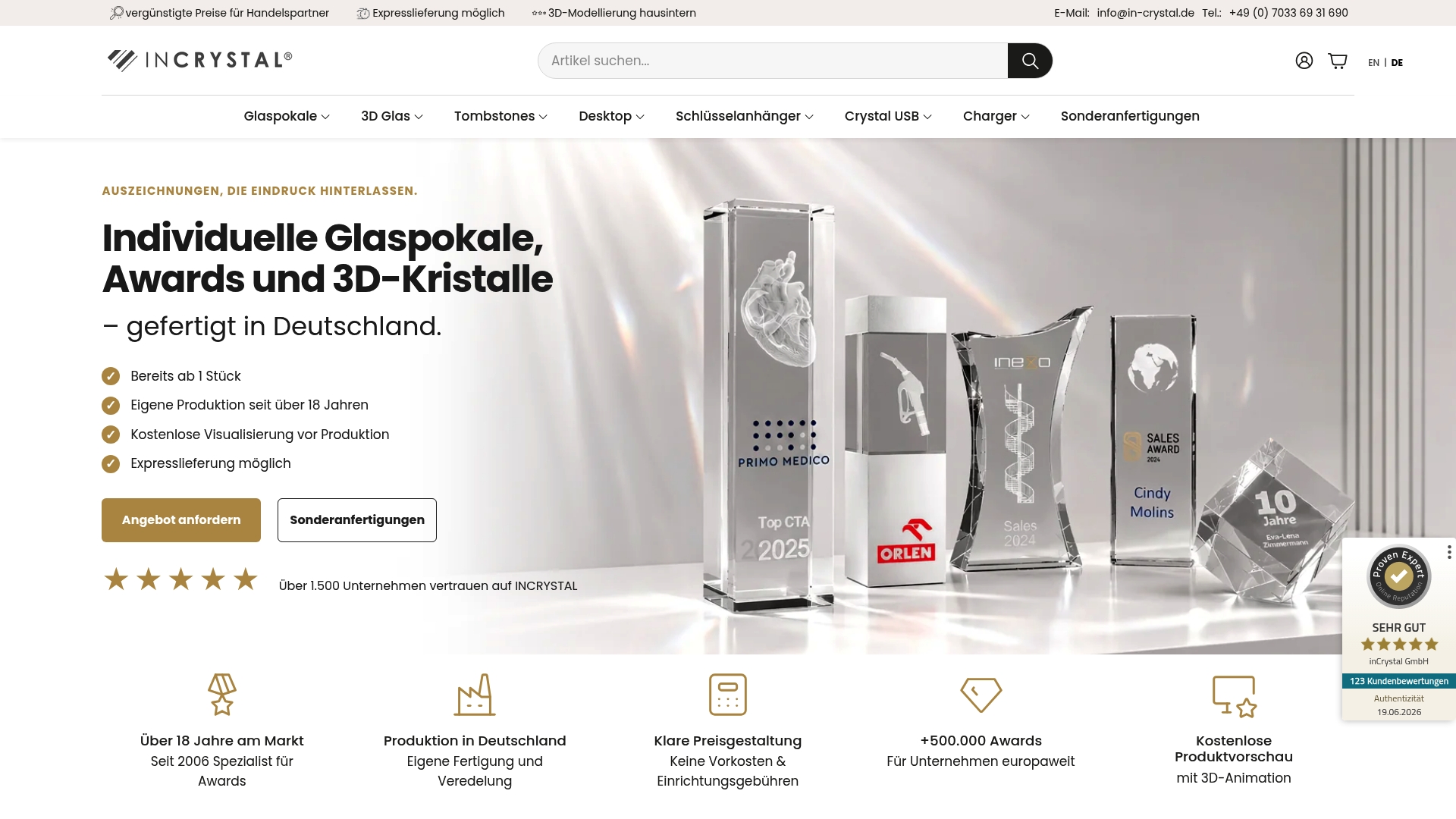
The service includes a free 3D preview and quotation preparationSo that you can see the finished object before production begins. Express delivery is possible. 3D modeling is done in-house. Hundreds of companies have already implemented their brand messages in glass with inCrystal.
FAQ
What file formats do I need for glass engraving?
Vector files in the formats AI, EPS or PDF are the standard. Raster images such as JPG or PNG do not deliver sufficient quality for precise engraving.
How long does it take to produce individual glass objects?
Individual glass moulds require a lead time of 3–6 months. Hybrid solutions with standard glass and individual decor are often available in a few weeks.
What decoration technology is suitable for corporate design glass objects?
Laser engraving is suitable for noble, durable optics for premium objects. Screen printing is more cost-effective for large quantities. High-temperature baking processes are the most durable method for colored logos.
Can I digitally check glass objects before production?
Yes. Digital 3D design tools enable realistic simulations of glass materials and significantly shorten coordination processes. inCrystal offers a free 3D preview.
What does it cost to adapt glass objects to the corporate design?
The costs depend on the technique, quantity and complexity of the form and are not listed publicly. inCrystal creates a free quote including 3D visualization on request.