




Posted by Andreas Vavelidis
on July 24, 2026

How can the ROI of exclusive glass promotional products be measured?
The ROI of high-quality glass awards does not result from the unit price alone. Those who only calculate manufacturing costs against sales see at most a fraction of the actual effect. The full return on investment is only reflected when financial, brand-related, relationship- and behaviour-oriented key figures are considered together. This 360° model of success has established itself as a reliable framework in practice.
Relevant key figures for exclusive promotional products:
- Financial KPIs: Cost per lead, cost per acquisition, revenue uplift in test versus control group
- Brand-related KPIs: Reminder value (supported and unsupported recognition), brand associations
- Relationship-related KPIs: Customer loyalty rate, repurchase rate, door opener effects in sales
- Behavioral KPIs:Website visits via QR code, participation rates at events, recommendations
Promotional products must be viewed across channels. Standardized metrics such as leads, reach and customer value across the entire business relationship (Customer Lifetime Value) make different campaigns comparable.
Contents
- Strategic approach to ROI measurement of glass awards
- 1. Use value-oriented KPIs instead of unit costs
- 2. Combine hybrid measurement methods
- 3. Qualitative insights in a structured way
- 4. Calculating long-term effects
- 5. Avoid typical errors in ROI measurement
- 6. Use sales attribution models
- How can the ROI be calculated quantitatively?
- How does the target group reaction affect ROI?
- How can the ROI be improved based on measurement data?
- inCrystal: Exclusive glass awards with measurable effect
- Important insights
Strategic approach to ROI measurement of glass awards
Reliable measurement of success begins before production. Anyone who only asks for the distribution, how the success should be measured, works retroactively and loses data.
Step 1: Set SMART Goals. SMART goals define clear expectations: specific, measurable, achievable, relevant and time-bound. A specific goal is, for example: “50 qualified leads within 8 weeks of the trade fair via the glass award tracking code.”
Step 2: Select KPIs by campaign goal. Lead generation requires other metrics than brand awareness. For customer loyalty, repurchase rate and churn reduction are more meaningful than pure distribution figures.
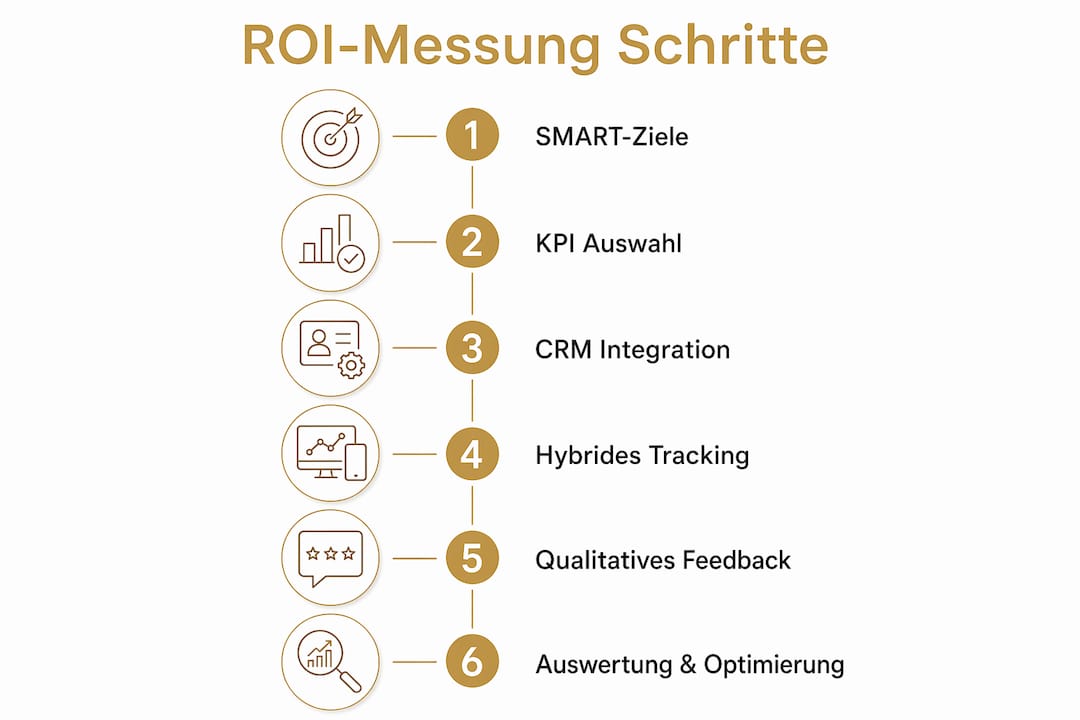
Step 3: CRM integration before campaign launch. A reliable measurement starts with the linking of customer data in the CRM system before the first distributed award. So it can later be understood whether recipients show a higher purchase frequency or loyalty.
Step 4: Set up hybrid tracking methods. QR codes on the award lead to a dedicated landing page. Individual tracking codes or UTM parameters connect the physical promotional product to digital evaluations in Google Analytics or the CRM.
Step 5: Collect Qualitative Data. Recipient feedback on short surveys, Net Promoter Score (NPS) and sales reports on call quality complement the figures.
Professional tip: Set up the tracking infrastructure (QR code, landing page, CRM tag) at least two weeks before campaign launch. Subsequent setup costs data and time.
KPI dashboards do not need to be complex software. A structured table with a target-actual comparison is often sufficient to make trends visible and communicate internally.
1. Use value-oriented KPIs instead of unit costs
Focus on the value per interaction significantly increases the significance of the analysis. A glass award that has been on a decision-maker's desk for six months generates brand contacts every day. This contact frequency flows into the effective contact price: manufacturing costs divided by the number of contacts over the useful life.

2. Combine hybrid measurement methods
Analog and digital tracking methods together provide the most complete image. QR codes on the award, individual discount codes and UTM parameters in campaign links connect the physical item with measurable online promotions. Offline touchpoints are transferred directly to analytics systems.
3. Qualitative insights in a structured way
Numbers show what happened. Qualitative data explains why. Short interviews with award recipients, sentiment analysis from social media mentions, and sales reports on exceptionally strong responses provide context that does not appear in any click statistics. Qualitative customer interviews reveal emotional impact and brand perception.
4. Calculating long-term effects
Some glass awards unfold their ROI for years. Rapid success measurements after four weeks often fall short for premium promotional products. Repurchase rate and brand associations influence the customer lifetime value and should be included in the KPI selection. Those who only measure short-term sales effects systematically underestimate the contribution to brand value.
5. Avoid typical errors in ROI measurement
Frequently tripping hazards: define KPIs without target reference, set up tracking only after distribution, or completely ignore qualitative data. Another mistake is the confusion of distribution rate and effect. Many distributed articles do not automatically mean many reactions. Common errors in Promotional Gifts often arise when choosing the article before the measurement even begins.
6. Use sales attribution models
Attribution models distribute achieved revenue to the touchpoints involved. Linear, time-decay or data-driven models show whether a glass award has generated awareness or contributed directly to the purchase decision. For B2B campaigns with long sales cycles, the time-decay model is often more meaningful because it weights younger contacts more.
How can the ROI be calculated quantitatively?
The basic formula: Profit from the campaign minus campaign costs, divided by the campaign cost, yields the return as a percentage. For glass awards, the profit is rarely directly visible. Indirect effects must therefore be estimated and documented.
Practical key figures for the calculation:
- Cost per lead (CPL): Total cost of the campaign divided by the number of leads generated
- Revenue uplift: Sales comparison between recipients and a control group without award
- CLV effect: Change of customer value for recipients compared to the previous period
A complete ROI calculation requires realistic assumptions. If you want to calculate the ROI correctly in marketing, you have to take into account all attributable income and costs, including sales time, logistics and personalization. Sound estimates are better than no number.
Professional tip: Form a test group and control group on the next campaign. Only the direct comparison shows which share of sales is actually attributable to the glass award.
How does the target group reaction affect ROI?
The degree of activation of the recipients is often more meaningful than the pure distribution number. An award that triggers a reaction, i.e. A photo on LinkedIn, a conversation at the next appointment or a direct request, generates measurable added value. This multiplier effect can be captured via social media monitoring, hashtag tracking and sales reports.
Target group segmentation improves accuracy. Decision-makers react differently than technical buyers. Those who evaluate recipient groups separately, recognize which segment delivers the highest ROI, and can target future campaigns. Glass gifts in customer relationships seem particularly strong when they fit the occasion and the recipient group.
How can the ROI be improved based on measurement data?
Data from ongoing campaigns shows which articles, which target groups and which distribution moments deliver the best results. This results in concrete adjustment screws:
- Adjusting article choice: If feedback shows that a particular design is photographed particularly often, it is worth investing in this format.
- Refine distribution strategy: Personal handover generates more reactions than anonymous mailing. For the data confirms this, the budget will be postponed accordingly.
- Optimizing timing: Campaigns that coincide with corporate events or industry fairs achieve higher activation rates.
- Iterate tracking codes: After each campaign, UTM evaluations show which channel has brought the most conversions.
Regular feedback loops and tracking in the campaign context make optimization data-based rather than intuitive. Those who do a structured evaluation after each campaign continuously improve the ROI.
inCrystal: Exclusive glass awards with measurable effect
If you use exclusive glass awards as promotional products, you need a manufacturer that combines quality, individuality and fast delivery. inCrystalFinishing individual glass trophies, awards and 3D crystals with unique subsurface engraving for over 18 years. Hundreds of companies in Germany rely on personal support and in-house 3D modeling.
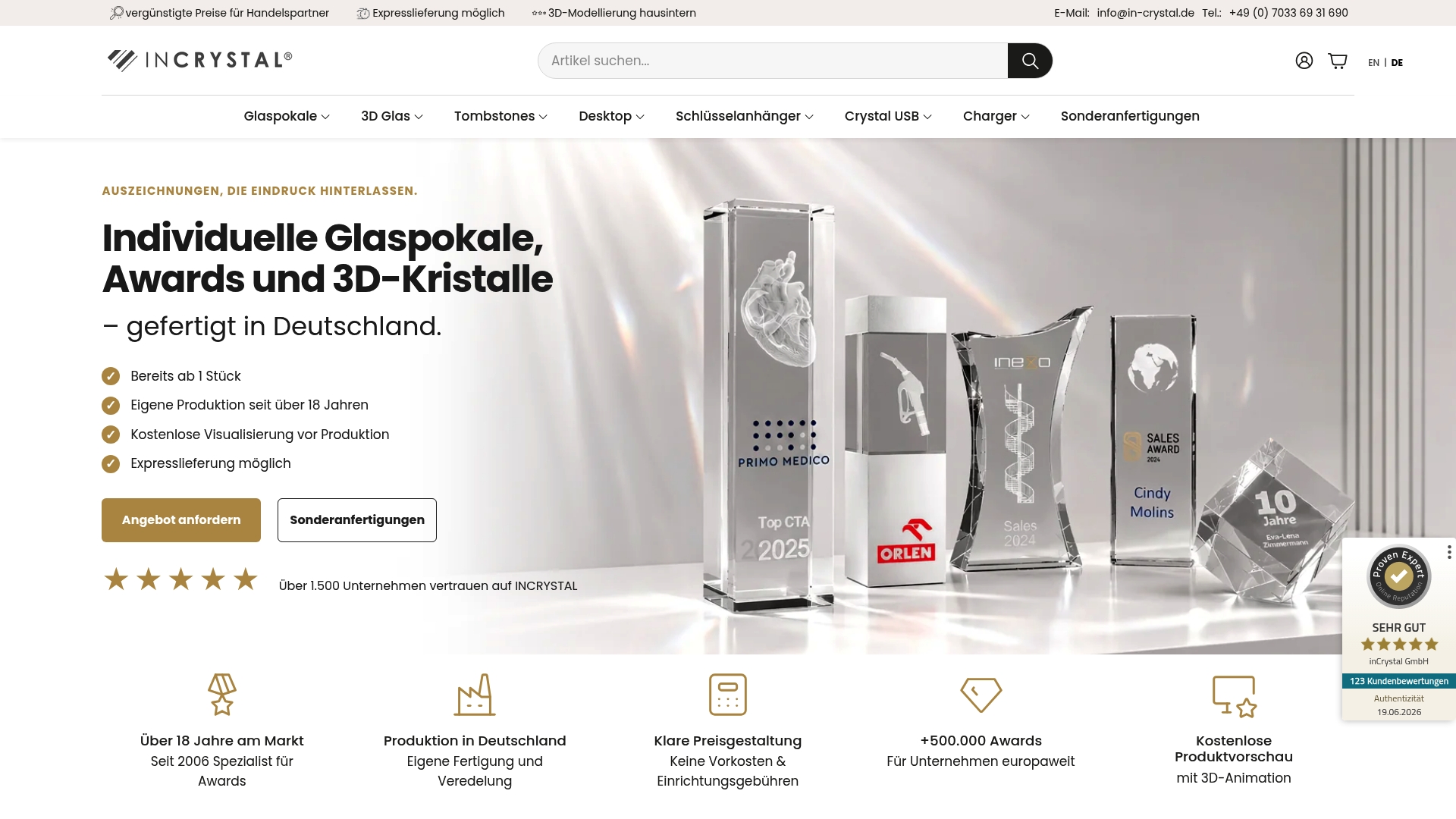
Each award is designed according to customer specifications. Free 3D visualization before production, express delivery possible. The result: a promotional item that does not disappear in the drawer, but remains permanently visible and thus creates the basis for measurable brand effect. Custom awards as Advertising explains how the deployment is specifically planned. Request your free 3D preview on.
Important insights
The ROI of glass awards will only become fully visible if financial, brand-related and behavioral KPIs are evaluated together.
| Topic | Details |
|---|---|
| Value-oriented KPIs | Costs per lead and sales uplift replace the pure unit cost consideration. |
| Hybrid measurement methods | QR codes and CRM data together provide the most complete picture of the campaign impact. |
| Early planning | CRM integration and tracking setup must be completed before campaign launch. |
| Long-term effect | Repurchase rate and customer lifetime value show the ROI for months and years. |
| inCrystal | Over 18 years of experience, free 3D visualization and express delivery for measurable brand presence. |