




Posted by Andreas Vavelidis
on July 29, 2026

Premium-class promotional products are exclusively manufactured, durable objects that combine brand equity, high-quality material and artisanal finishing. No giveaway, no mass product. Typical examples: a 3D glass cube with subsurface engraving, an engraved glass trophy as a corporate award or a crystal block with LED base for VIP customers. inCrystal (inCrystal GmbH) has specialized in exactly this category for over 18 years.
Tax note: In Germany, gifts to people who are not employees of the giving company are generally deductible as business expenses up to a total of €50 per recipient and financial year. Whether the net or gross value applies depends, among other things, on input-tax eligibility; the specific tax treatment and documentation requirements should be reviewed case by case.
- 3D glass cube with subsurface engraving (corporate logo, date, initials)
- Engraved glass glass trophies and awards for awards
- Crystal block with LED base as VIP gift
- USB crystal with integrated 3D engraving
Professional tip: Consider the €50 limit and the required documentation during the briefing. For higher-value glass and crystal products, recipients, value and occasion should be recorded transparently and the tax treatment reviewed case by case.
Contents
- How do you recognize a high-quality promotional item?
- Why do companies invest in premium gifts?
- How to choose the right premium gift?
- Specific examples: glass and crystal products in company use
- What processes make a glass product really premium?
- Realistically assess delivery times, minimum quantities and budget limits
- Why does inCrystal fit as a supplier of glass and crystal products?
- Ordering at inCrystal: Step by step
- Important insights
- What really matters with premium promotional products
- Send exclusive glass and crystal products directly at inCrystal
How do you recognize a high-quality promotional item?
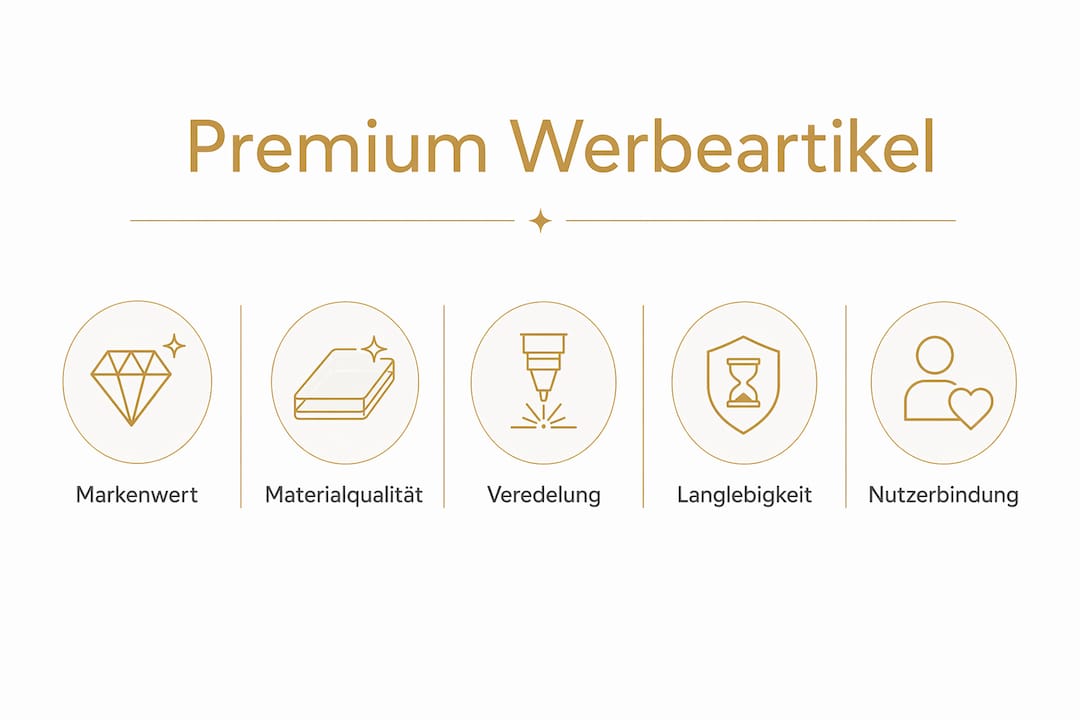
An article is considered a premium if it meets at least two out of three axes: brand value, material quality or finishing quality. Industry frameworks recommend this three-axis logic as a minimum standard.
For glass and crystal, the material axis is decisive. Optical clarity, grinding accuracy and the distinction between crystal glass and simple float glass are visible quality indicators. Crystal glass breaks the light differently, feels heavier and looks more durable.
Finishing forms that mark premium:
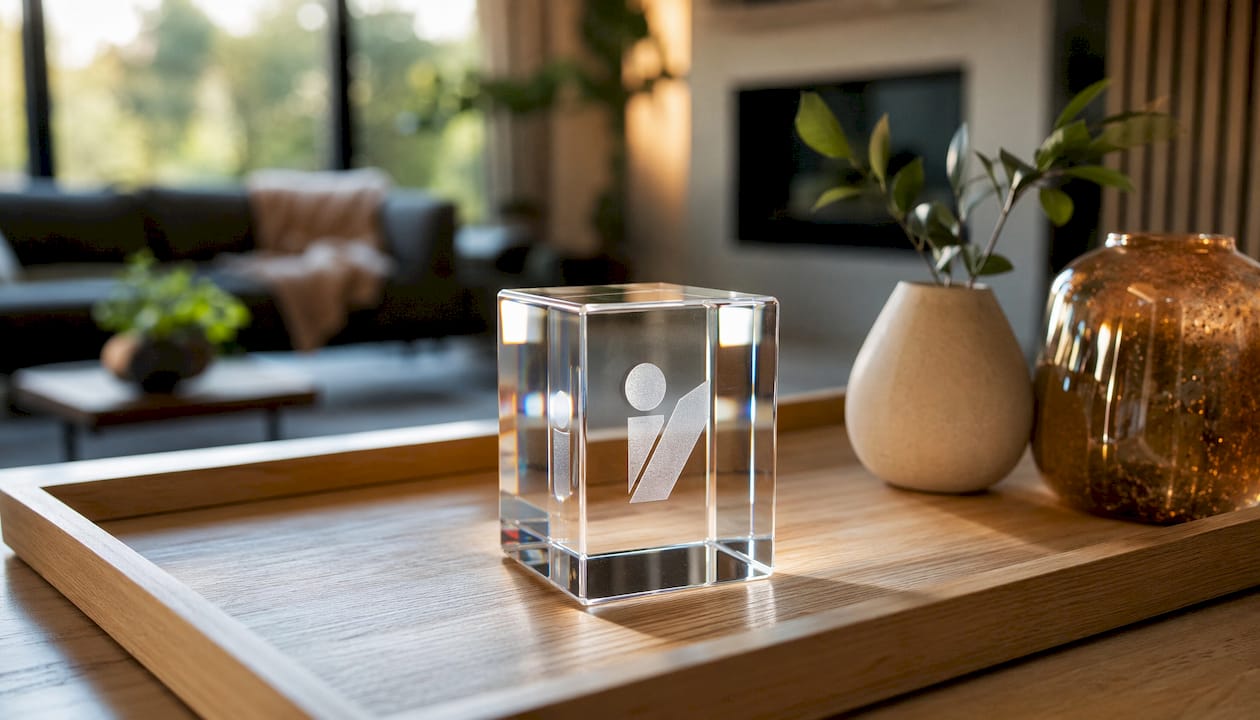
- 3D laser subsurface engraving: Motif is created inside the glass, surface remains smooth
- Surface laser engraving: Precise, durable, monochrome
- Mirror polish: High gloss surfaces on edges and base
- Chrome base or LED integration: Haptic and optical enhancement
Discreet finishing beats striking logo. A glass cube with a fine subsurface engraving is used privately. An object with a large print lands in the drawer.
Professional tip: Prefer engraving methods that integrate the motif into the substance instead of apply to the surface. Inner engravings are scratch-resistant, UV-resistant and do not age.
Why do companies invest in premium gifts?
Appreciation and long-term customer loyalty are the primary goals. A glass object that has stood on the desk for years reminds daily of the sender. This is a long-term brand effect without running advertising costs.
Everyday suitability is the key to ROI. An article that is used pays for years. Giveaways are used once or disposed of immediately.
- Small editions for defined target groups: Executives, Key Accounts, VIP Clients
- Occasions: Company anniversary, conclusion of contract, product launch, end of year
- Demarcation: Premium items do not replace mass advertising, they complement it specifically
When premium is not worth it: with very high quantities (over 500 units) with a pure awareness target or if no personal transfer moment is planned. For trade fair giveaways, cheaper alternatives make more sense.
High-quality promotional products are particularly suitable when it comes to larger sums, demanding target groups are to be addressed or a long-term brand loyalty is sought.
How to choose the right premium gift?
A structured selection saves costs and avoids incorrect orders. The following questions will help with the briefing.
- Anyone who is the recipient? (manager, key account, employee)
- What occasion? (Anniversary, Award, Christmas, Onboarding)
- What use value should the object have?
- Does the design fit the corporate identity?
- Is packaging planned?
- What number of pieces is realistic?
- What is the budget per piece (net)?
- Are there any sustainability requirements?
Specific questions to the supplier:
- Material proof and glass specification available?
- Sample piece possible before series release?
- 3D preview before production included?
- Delivery time Standard and Express?
Professional tip: Always order a sample before releasing the series. A free 3D Preview shows the final result before even a piece is produced.
For accounting, keep a price breakdown, the occasion and a recipient list. Deductibility and any possible flat-rate taxation should be reviewed case by case.
Specific examples: glass and crystal products in company use
Glass gifts in customer relationships work the most when the product and the occasion match.
- 3D glass cube with subsurface engraving: Corporate logo or anniversary date inside. Suitable for CEO gifts and corporate awards.
- Engraved glass trophy: Classic award for sales competitions or employee anniversaries. Individual with name and date.
- Crystal base with LED base:High-quality table presentation for VIP customers and trade fair key contacts.
- USB crystal with 3D engraving: Technology integration meets glass aesthetics. For customers who value functionality.
- Small glass blocks in set: For smaller budgets or multipacks for team gifts.
Occasions and suitable formats:
- Company anniversary: 3D glass cube with year and corporate logo
- CEO farewell: crystal cube with initials, without logo
- Key account maintenance: Engraved glass trophy with personal dedication
- Trade fair appearance (key contacts): USB crystal with subsurface engraving
Professional tip: A set of glass object, gift wrapping and handwritten card significantly increases the perceived value. The packaging is part of the impression.
What processes make a glass product really premium?
Production technology determines durability and effect.
| Procedure | Description | Suitability |
|---|---|---|
| 3D laser subsurface engraving | Motif in the interior of the glass, surface untouched | Logos, portraits, complex motifs |
| Surface laser engraving | Precise engraving on the outside | Text, initials, simple graphics |
| Depth engraving | Mechanically incorporated depression | Writings, coats of arms |
| Mirror polish | High gloss on edges and bases | Haptic upgrade |
| LED base Integration | Lighting from below | Table presentation, awards |
Quality features of the glass itself: optical purity without streaks, uniform edge grinding, weight as an indicator of material thickness. Coating-free surfaces are a prerequisite for permanent subsurface engraving.
- Crystal glass has higher refraction than float glass
- Temperature resistance when pressing the engraving is technically relevant
- Anti-reflective coating on base surfaces prevents unwanted reflections
Professional tip: Ask for the glass purity class. Optical glass without air bubbles or streaks is the difference between a premium object and a series product.
Realistically assess delivery times, minimum quantities and budget limits
Typical production times:
Briefing and design release in a few working days 3D preview and correction in one to two working days optional sample production within a few additional working days Series production depending on quantity in one to two weeks Express delivery available on request
Minimum quantities vary depending on the procedure. Unique pieces are possible with 3D subsurface engraving, but more expensive per piece. From about 10 units, the personalization costs decrease noticeably.
Budget orientation for glass and crystal products: Industry recommendations cite moderate per capita values as an entry into the premium segment, depending on the category. Glass and crystal objects with 3D subsurface engraving are correspondingly in the upper premium range.
Additional costs, which are often underestimated:
- Special packaging and gift box
- Personalization per piece for small print runs
- Express surcharge at short lead
- Delivery insurance for fragile goods
Why does inCrystal fit as a supplier of glass and crystal products?
inCrystal (inCrystal GmbH) has been finishing individual glass trophies, awards and 3D crystals for over 18 years. The 3D laser subsurface engraving is conducted in-house.
Features at a glance:
- Free 3D visualization before placing an order
- Express delivery on request
- Individual consulting for corporate clients
- Hundreds of corporate customer references
- Own production without external third-party suppliers
Suitable projects: corporate awards, single gifts for executives, prestige sets for key accounts, anniversary gifts with personal engraving.
The free 3D preview shows the final object before production. Changes are possible at this stage without additional costs. Production only starts after approval.
Professional tip: Use the 3D preview as a release document internally. This way you avoid questions in production and speed up the process.
Ordering at inCrystal: Step by step
- Briefing: Target group, occasion, quantity, budget, engraving motif
- 3D Preview: Free visualization, correction loop possible
- Pattern (optional): Physical pattern before series release
- Release: Written confirmation of the design
- Production: Series runs with quality test
- Shipping: With shipping insurance, express options available
Important questions to the supplier before ordering:
- What glass specification is used?
- Is a recall regulated in the case of quality defects?
- How are packaging tests for fragile goods documented?
- What personalization options are possible with small runs?
For accounting, request a price breakdown per item and document the occasion and recipient. The specific tax treatment should be reviewed case by case.
Important insights
Premium promotional products made of glass and crystal combine material quality, manual finishing and long-term usability and are thus an effective category in corporate gifting for defined target groups.
| Topic | Details |
|---|---|
| Definition Premium | At least two axes meet: brand value, material quality or finishing quality. |
| Tax limit | Generally €50 per recipient and financial year for business-expense deductibility; review details and documentation case by case. |
| Target group and circulation | Small quantities for executives and key accounts; no mass distribution. |
| Selection process | First clarify the target group and occasion, then choose material and finishing, sample before series release. |
| inCrystal | Over 18 years of experience, free 3D preview, express delivery, in-house 3D modeling and finishing. |
What really matters with premium promotional products
Most buyers ask for the price first. That's understandable, but it's the wrong order. A glass object for €60 looks cheaper than one for €40 if the engraving is fuzzy or has the glass of streaks. Quality is visible and tangible.
Data-driven approaches to target group segmentation show that those who know their recipients better choose. A CEO gift does not need a logo front. A date or initials are enough and look more sovereign.
Discreet finishing is not a compromise. It is the better strategy. An object without a dominant logo is used privately. And this is exactly where the brand effect arises, which no giveaway ever reaches.
Send exclusive glass and crystal products directly at inCrystal
inCrystal manufactures individual Glass glass trophies and awards and 3D glass cubes for corporate customers. free 3D preview before production, express delivery on request, hundreds of corporate customer references.
Suitable for awards, anniversary gifts, key account presents and VIP sets. Unique pieces and small runs possible. Request your free 3D preview now or get an individual offer directly.