




Posted by Andreas Vavelidis
on July 10, 2026

3D engraving is a high-precision laser engraving process that produces three-dimensional, tangible structures directly in materials such as glass, metal or wood. Promotional products with this technique look more valuable, stay in memory longer and achieve a significantly higher advertising effect in the B2B sector than printed or pasted alternatives. If you ask why 3D engraving makes promotional products superior, you get a clear answer: Haptic, durability and precision together create a quality that does not reach imprint. For companies and organizers who want to present their brand message permanently, the 3D subsurface engraving is not a luxury. It is the most effective tool in the promotional products range.
Why 3D Engraving Makes promotional products Technically Superior
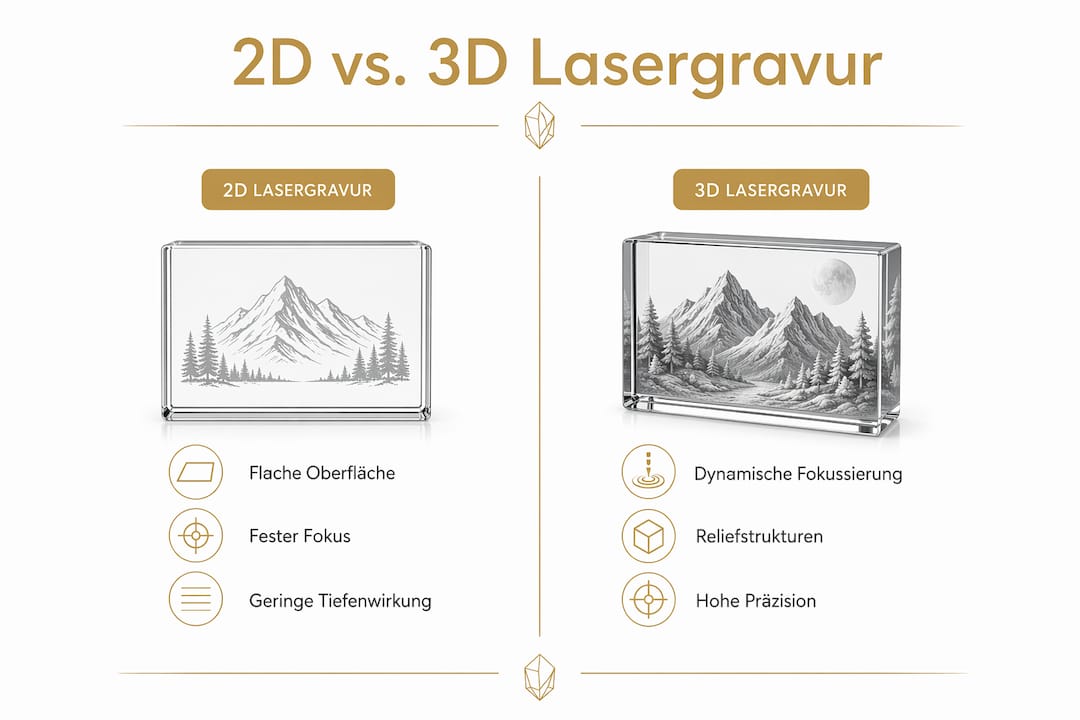
3D laser engraving systems work with a dynamic Galvo scanner head that adjusts laser focus in real time along the Z-axis. This is the key difference to 2D systems that can only engrave evenly on flat surfaces. At 3D laser subsurface engraving the engraving depth remains constant even on curved or irregular surfaces, because the focus of the surface follows.
2D, 2.5D and 3D laser systems differ fundamentally in focus control. -3D systems adjust the focus in real time, engraving precisely on uneven surfaces. This means: No retensioning, no special devices, no loss of time in series production.
Specifically, the process proceeds like this:
- The 3D model of the motif is loaded into the control software.
- The Galvo scanner head calculates the focus depth for each point of the surface.
- The laser engraves layer by layer with consistent intensity.
- The result is a deep, uniform relief structure without post-processing.
Automated 3D laser engraving systems are much faster and deliver consistent quality compared to manual methods. This makes them economically attractive for series productions, because error rates decrease and lead times become shorter.
Professional tip: If you are planning promotional products in larger quantities, you should calculate the series production with 3D laser systems. Unit costs are significantly reduced at higher quantities, while the quality remains constant.
For complex surfaces, 3D focusing is not a gimmick, but a necessity to ensure even engraving depth. Anyone who ignores this, risks uneven results that reduce the value of the promotional item.
Why 3D engraving in marketing is more sustainable than imprint
Engraved promotional products generate a strong emotional resonance, which is often underestimated. They promote customer loyalty and increase brand perception over a long period of time. A printed pen ends up in the trash after weeks. An engraved glass cube with the corporate logo is on the desk for years.
“3D effects and relief structures create a stronger emotional bond and make promotional products more valuable and durable in use. Studies show higher perception and efficacy in the B2B range through personalized 3D engravings."
Feel is an underestimated channel. Anyone who touches an article that feels high-quality, combines this feeling with the brand behind it. This is not a coincidence, but a measurable effect.
The advantages over prints and stickers at a glance:
- Durability: Engravings are abrasion-resistant and do not age. Prints fade, stickers peel off.
- Perception: Ed items are more commonly perceived as personal gifts, which increases the useful life.
- Value: In the B2B sector, an engraved article signals quality and appreciation to the recipient.
- Tax Efficiency: For gifts to business friends, the tax requirements and the 50-euro limit per recipient per year must be examined; the concrete treatment should be coordinated with the tax consultancy.
3D laser engraving allows deep relief structures that promote more sustainable use than purely optical 2D prints or stickers thanks to their feel and optics. That's the core difference when you ask why 3D engraving is better than imprint.
What materials and products are suitable for 3D engraving advertising?
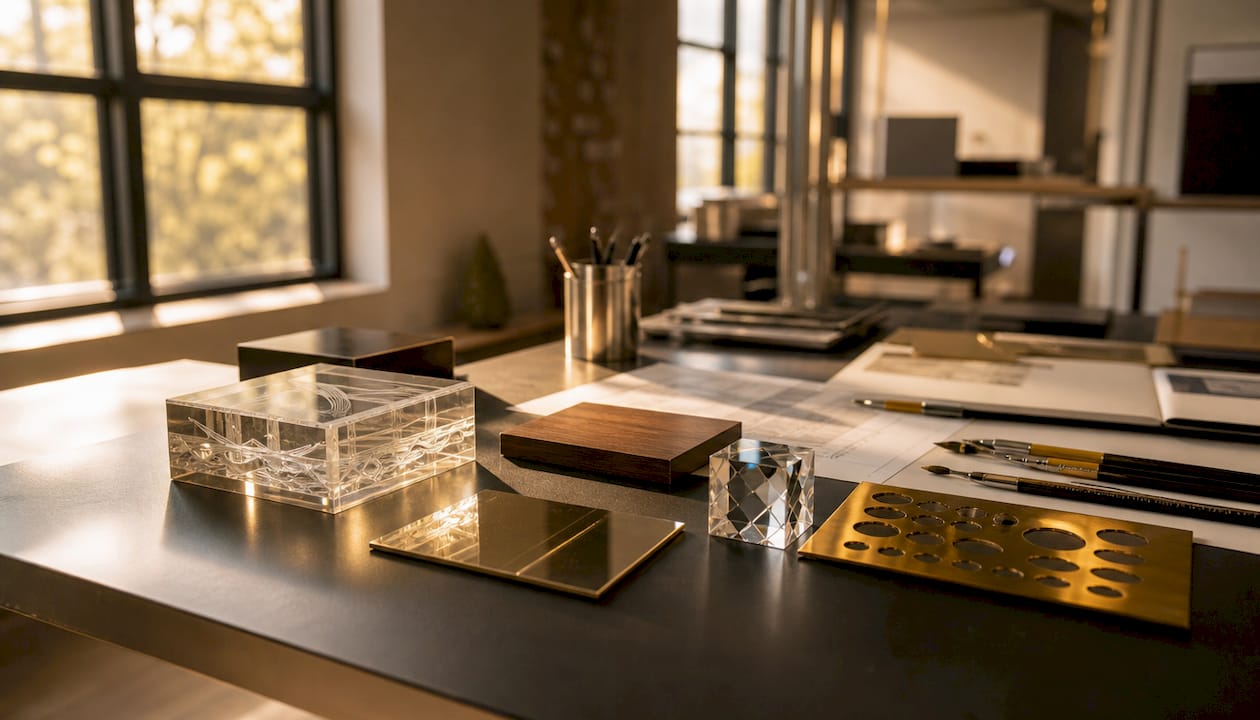
3D laser engraving works on a wide range of materials. Each material has its own strengths that make the choice of the right carrier a strategic decision.
| Material | Engraving effect | Typical products |
|---|---|---|
| Glass | Very high, three-dimensional depth effect | Glass cubes, trophies, trophies |
| Metal | High, high contrast surface | Pens, keychains, plates |
| Wood | Warm, natural look | Cutting boards, frames, stands |
| Acrylic | Sure, bright when it comes to backlight | Displays, awards |
| Plastic | Functional, cost-effective | Everyday items, office supplies |
The engraved surface remains durable and resistant to abrasion and environmental influences. This is especially true for glass and metal, which still look flawless even after years.
Glass is the material with the strongest depth effect. A Glass cube with 3D subsurface engraving shows the motif floating inside the material. This is not optically reproducible, neither by pressure nor by 2D engraving. For companies that want to leave a lasting impression on customer gifts, glass is the first choice.
Professional tip: Compact glass blocks are particularly suitable for trade fairs and events. They are easy to transport, look high-quality and can be individually engraved with logo and event date. inCrystal offers a free 3D preview before the production starts.
For the care of engraved glass products: water and a soft cloth are enough. No abrasives, no ultrasonic cleaners. - Depending on the surface, metal and wood articles occasionally require easy care, but remain generally low-maintenance.
How can 3D-engraved promotional products be integrated into marketing strategies?
Targeted promotional products with 3D engraving increase brand awareness and create sustainable customer loyalty in the B2B sector. Statistics show increased retention rates and advertising effect on personalized high-quality promotional products. In concrete terms, this means that an engraved article stays with the recipient longer than a printed one, and each use is another point of contact with the brand.
For companies and organizers, this results in clear fields of application:
- Trade fairs and congresses: Engraved glass products as a conversation starter at the stand. They stand out, are taken away and do not end up in conference pocket waste.
- Customer Gifts: A Personalized glass trophy with the name of the recipient or the common project year, a personal bond generates that does not create a standard gift.
- Employee Awards: En engraved trophies for anniversaries or achievements have a symbolic value that goes far beyond the material value.
- Product launches: An engraved article as an accompaniment to the product launch combines the new product with a physical, permanent object.
Anyone who Personalized promotional productsInvolving in its brand communication benefits from an effect that digital advertising cannot generate: physical presence in the recipient's everyday life. Because a screen continues to scroll. An engraved glass cube on the desk remains.
3D laser engraving also opens up new opportunities for influencer marketing and branding. High-quality, individually engraved objects are suitable as unboxing experiences and create organic range because they are visually striking and unique. That's an approach that many companies aren't taking advantage of yet.
In the B2B sector, the logic of promotional products is fundamentally different from B2C. Decision-makers receive many gifts. What remains is what radiates quality and has a personal reference. Engraved items meet both criteria.
Important insights
3D engraving is the superior method for promotional products because it combines feel, durability, and individual depth effect that does not reach an imprint or sticker.
| Topic | Details |
|---|---|
| Technological advantage | The Galvo scanner head adjusts the focus in real time and engraves precisely on any surface. |
| Advertising impact | Engraved items stay with the recipient longer and create more brand contacts than printed alternatives. |
| Material choice | Glass produces the strongest depth effect; metal and wood are suitable for other target groups and budgets. |
| Tax efficiency | For gifts to business friends, the tax requirements and the 50-euro limit per recipient per year must be checked. |
| Fields of application | Trade fairs, customer gifts, employee awards and product launches benefit most from 3D engraving. |
inCrystal: 3D engraving items made to measure
inCrystal has specialized in individual glass engravings, trophies and 3D crystals for over 18 years. The range ranges from compact glass blocks for trade fairs to Exclusive promotional gifts for key customers.
Each order starts with a free 3D visualization. Companies see the final product before production starts. Express delivery is possible. 3D modeling is done in-house, which guarantees short coordination distances and fast implementation. If you are looking for high-quality, engraved promotional products that are really remembered, inCrystal will find the right product. Request a free quote and start directly.
FAQ
What is the difference between 2D and 3D laser engraving?
2D laser engraving works on flat surfaces with a fixed focus. -3D laser engraving dynamically adjusts the focus along the Z-axis, engraving precisely on curved and irregular surfaces.
Why are engraved promotional products better than printed ones?
Engravings are abrasion-resistant, do not age and are more often perceived as personal gifts. Prints fade and stickers detach, which ends the advertising effect after a short time.
What materials are suitable for 3D engraving promotional products?
Glass, metal, wood, acrylic and plastic are all suitable. Glass produces the strongest depth effect and is particularly suitable for high-quality customer gifts and awards.
How long does the production of engraved promotional products take?
Delivery time depends on the supplier, the execution, the number of pieces and the approval. Express options are possible and significantly reduce production time when urgently needed.
Are engraved promotional products tax-deductible?
For gifts to business friends, the tax requirements and the 50-euro limit per recipient per year must be examined; the concrete treatment should be coordinated with the tax consultancy. Exact tax treatment depends on the individual situation and should be clarified with a tax advisor.