




Posted by Andreas Vavelidis
on July 12, 2026

Sustainable promotional gifts are environmentally friendly, durable products with transparently documentable material certificates that companies use to credibly position their brand. The term "sustainable promotional gifts" is a common marketing term; the industry speaks more precisely of ecological promotional products or sustainable promotional products. Three criteria are decisive: the choice of materials with recognized certificates such as GRS or FSC, the longevity of the product in everyday life and the transparency of the supply chain. Those who meet these criteria strengthen brand values and avoid competition risks through blanket eco-promises without proof. This overview gives marketing professionals a practical basis for the selection in 2026.
1. Main ecological materials for sustainable promotional gifts
The choice of materials is the foundation of every sustainable promotional item. Recycled PET, FSC paper, organic cotton, bamboo and cork are popular options for ecological promotional products in 2026. Each material has specific strengths and suitable product categories.
rPET (recycled polyethylene terephthalate)

rPET is made from collected plastic bottles and carries the GRS certificate (Global Recycled Standard). Typical products are backpacks, carrier bags and fleece jackets. The recycling share must be indicated on the product or the delivery note, otherwise the documentability is missing.
FSC Certified Paper and Cardboard
The Forest Stewardship Council (FSC) seal is responsible for forest management. Notebooks, calendars and packaging materials made of FSC paper are widely used and well scalable. Important: The seal must be visible on the final product, not only on the raw material.
Organic cotton with GOTS standard
Organic cotton according to the GOTS (Global Organic Textile Standard) standard excludes pesticides and pollutants in production. Carrying bags, T-shirts and aprons made of GOTS cotton are suitable as employee gifts. The GOTS standard also examines social working conditions, which increases the added value.
Bamboo and Wood
Bamboy grows without pesticides and is ready for harvest in a few years. Ballpoint pens, cutting boards and drinking cups made of bamboo are cheap to manufacture and easily printable. Wood products from certified forestry offer similar advantages and have a high-quality effect.
Cork, upcycling and other materials
Cork is a renewable raw material from the bark of the cork oak, which is not precipitated. Upcycling products from industrial waste or disused materials often have a particularly credible sustainability history. Recycled plastics with a post-consumer content complete the list of materials.
| Material | Certificate | Typical products |
|---|---|---|
| rPET | GRS | Bags, backpacks, textiles |
| Paper/carton | FSC | Notebooks, packaging |
| Organic cotton | GOTS | T-shirts, carrier bags |
| Bamboo | No duty, but auditable | Pens, cups, cutting boards |
| Cork | No duty | Coasters, wallets |
Professional tip: Always ask the supplier for proof of certificate as a PDF, not only the logo on the website. Only a verified document protects against warnings.
2. Longevity and utility value as decisive success criteria
The ecological effect of a promotional gift is shown above all by the direct replacement of consumables and the useful life in everyday life. A promotional item that is used daily generates more brand visibility than ten items that disappear after a week in the closet.
Durable drinking bottles made of stainless steel and bamboo lunch boxes avoid hundreds of disposable items per user every year. This is not a marketing promise, but a measurable effect. Those who give their customer a stainless steel bottle replace potentially 500 disposable cups per year.
Long giveaways with real utility promote long-term customer loyalty and better brand perception. A product that is in the hand every day reminds us of the brand behind it every day.
Greenwashing often arises right here: a company advertises a "sustainable" article that is disposed of after a short time. Specific examples of use help to avoid this.
Products with high utility in everyday life:
- Stainless steel bottles with engraving for daily use
- Reusable bamboo or stainless steel lunch boxes
- High-quality fabric bags made of organic cotton for shopping
- Book notebooks made of FSC paper with fixed cover for everyday office life
- Wood or bamboo ballpoint pen as a desk attendant
Professional tip: Choose products that the recipient would keep without your logo. This is the simplest test for real utility.
3. Selection criteria and check checklist for sustainable promotional products
Transparent supply chain and evidence such as GRS or FSC prevent greenwashing and secure brand trust. Unsubstantiated environmental statements can trigger reputational and competitive risks. Unclear terms such as "climate neutral" without proof are legally risky.
The following checklist helps with the safe product selection:
- At least one verifiable certificate available? GRS, FSC, GOTS or an equivalent standard must be detectable on the product or in the delivery documentation.
- Material information complete and transparent? The supplier must be able to confirm the material composition and origin in writing.
- Processing low-emission? Test for OEKO-TEX certification for textiles or reach conformity for plastics.
- Finishing sustainably designed? Water-based printing inks and solvent-free processes are standard with reputable suppliers.
- Packaging ecological? Grass paper or recycled cardboard reinforces the ecological message and is immediately perceptible when unpacking.
- Passed greenwashing exam? No blanket terms without receipt. Specific recycling shares and certificate numbers.
| Criterion | Minimum requirement |
|---|---|
| Certificate | GRS, FSC, GOTS or equivalent |
| Material information | Full composition in writing |
| Free of pollutants | OEKO-TEX or Reach-compliant |
| Finishing | Water-based paints, solvent-free |
| Packaging | FSC carton or grass paper |
Marketing should name specific recycling shares and certificates to increase credibility. This applies not only to product communication, but also to internal procurement documents. Those who replace generic promotional products with verifiably sustainable ones avoid the most common Errors in promotional products.
4. Situational recommendations: Sustainable gifts depending on the occasion
Choosing the right sustainable promotional item depends on the occasion, the target group and the budget. A trade fair gift must meet different requirements than a customer gift at the end of the year. The Trends 2026 in Corporate Gifting show clearly: Personalization and utility beat mass.
Trade fairs and events
Easy, transport-friendly items are mandatory here. Seed paper with wildflower mix, FSC notebooks in A6 format or bamboo ballpoint pen fit in any pocket. The packaging made of grass paper reinforces the first impression at the stand.
Employee gifts
Durable textiles made of GOTS-certified organic cotton or high-quality stainless steel bottles with engraving look appreciative. Employees use such items daily, which strengthens internal brand loyalty. Quality before quantity is the right decision here.
Customer Gifts
Convince neutral, professional designs with real utility. A high-quality glass trophy or a 3D crystal from inCrystal with individual engraving is a gift that is not thrown away. Such Corporate Gifts with Effect remain visible on the recipient's desk.
Tech-savvy target groups
Sustainable gadgets made of wood or recycled plastic appeal to this group. Wireless charging pads made of bamboo or USB hubs made of rPET combine functionality with ecological standards. Important: Here, too, the certificate obligations apply.
Budget tips
For tight budgets, the following applies: Utility value, material clarity and certificates take precedence over extras such as take-back logistics or elaborate special packaging. Prefer less piece in better quality than many cheap items without proof. Relay prices depend on the product, the refinement and the ordered quantity.
Sustainable marketing strategies pay off in the long term. The benefits of sustainable marketing strategies for brand equity and growth are well documented. Those who rely on provable sustainability at an early stage build a competitive advantage that becomes even more important with upcoming legal requirements such as the PPWR 2026.
5. Social responsibility as part of the overall sustainable picture
Ecological giveaways must take into account the entire supply chain, including social responsibility and environmentally friendly packaging. This is not an optional extra, but part of a credible sustainability strategy.
Products that are linked to social projects, such as drinking water donation projects or Fairtrade certifications, increase the perceived value of the gift. The recipient sees not only a product, but a posture. This strengthens brand loyalty on a different level than pure logo printing.
The Types of branded gifts range from simple giveaways to high-quality awards. Anyone who knows the entire spectrum, makes better decisions. Social responsibility can also be expressed by the choice of regional suppliers, which shortens transport routes and strengthens the local economy.
Important insights
Sustained promotional products only appear credible if material certificates such as GRS, FSC or GOTS can be proven and the useful value in the everyday life of the recipient is high.
| Topic | Details |
|---|---|
| Material choice | rPET, FSC paper, GOTS cotton and bamboo are among the commonly mentioned materials in 2026. |
| Certificate requirement | GRS, FSC or GOTS must be documented, not just on the website. |
| Longevity decides | Products with daily utility value replace disposable items and increase brand visibility. |
| Avoid greenwashing | Broad environmental claims without reliable evidence are risky under competition law. |
| Budget priority | Useful value and certificate before quantity: fewer items in better quality. |
inCrystal: Individual glass engravings as durable promotional products
If you are looking for a giveaway that does not disappear in the closet, you will find a clear answer at inCrystal. Glass trophy and 3D crystal with individual subsurface engraving are products that retain recipients because they are aesthetic and unique. Longevity is not a promise, but the essence of the material.
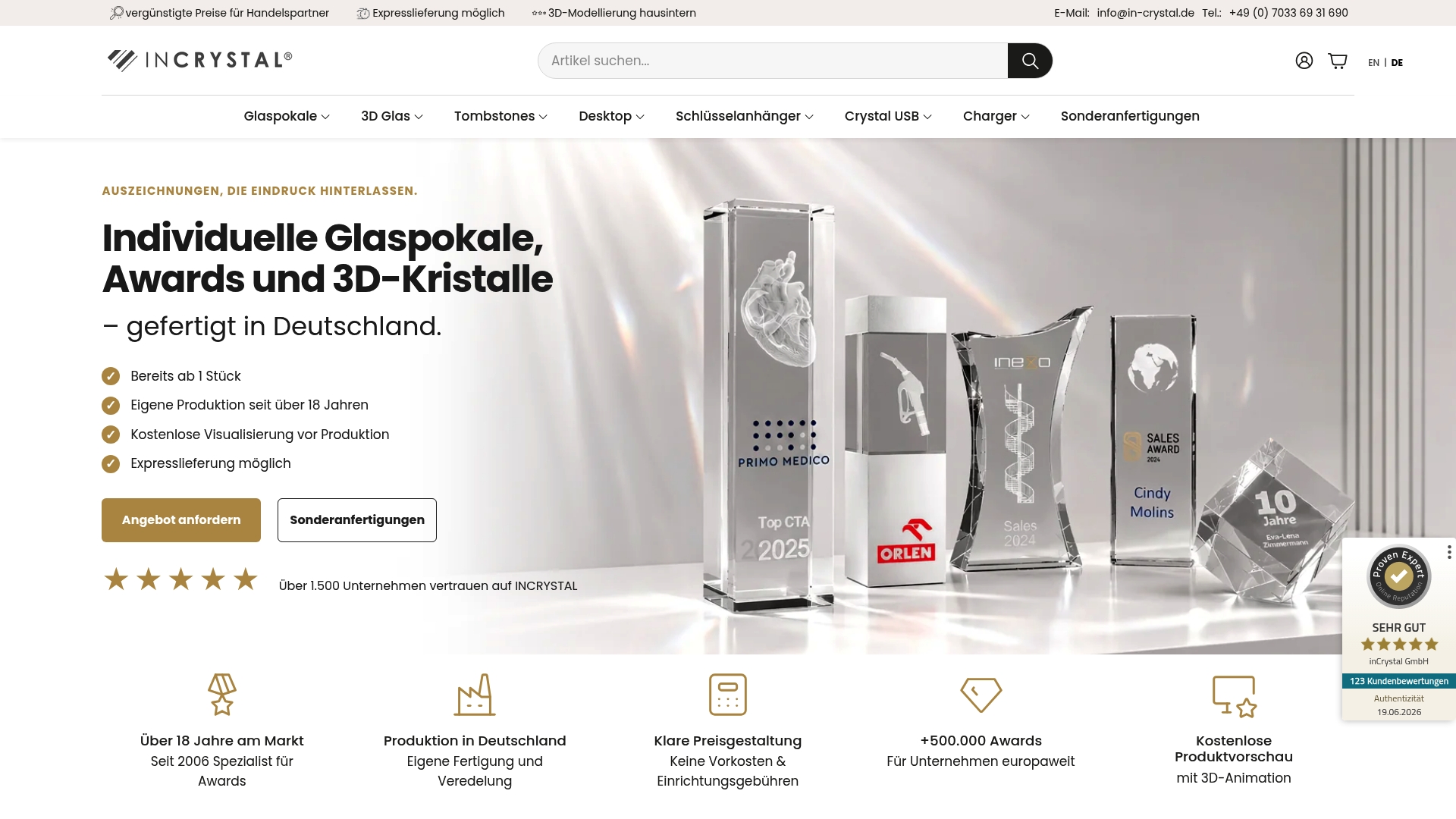
inCrystal offers a free 3D preview to use to see your corporate logo or brand message in the glass before ordering. In-house 3D modeling allows individual adjustments at no extra charge. Express delivery is possible. Hundreds of companies have thus replaced generic promotional products with something that really remains.
FAQ
What makes a giveaway sustainable?
A promotional gift is considered sustainable if it is made of verifiable ecological materials, carries at least one verifiable certificate such as GRS, FSC or GOTS and replaces disposable items with its longevity.
What certificates are important for sustainable promotional products?
GRS (Global Recycled Standard) for recycled materials, FSC for paper and wood and GOTS for organic textiles are the most important evidence. Sustainability claims should be specifically documented and legally verified; certificates can serve as proof.
How do I choose sustainable giveaways on tight budget?
Prioritize utility, transparent material specifications and certificates before extras such as special packaging. fewer items in proven sustainable quality than a large quantity without evidence.
Are glass products sustainable giveaways?
Yes. Glass is a durable, recyclable material. Products such as the 3D crystals from inCrystal last for decades and replace disposable items with a gift that the recipient retains permanently.
What is greenwashing in giveaways?
Greenwashing refers to the use of flat-rate eco-promises without evidence. Package terms such as “climate neutral” or “friendly” should only be used with concrete, reliable proof and legally tested.