




Posted by Andreas Vavelidis
on July 14, 2026

Promotional products are defined as physical brand ambassadors handed over to customers, partners or employees to generate brand recall and retention. Those who consistently apply the brand identity promotional products best practices avoid scattering losses and achieve measurably better results than with generic giveaways. Three factors are decisive: the right selection according to the target group and occasion, high-quality personalization and a planned use along fixed contact points. Companies that ignore these principles are giving away budget and risk their brand appearance acting inconsistently.
1. What criteria really count when choosing promotional products
Functionality is the most important selection criterion for promotional products. An article that is used in everyday life generates recurring brand memories and lowers the friction in customer contact. Cheap items without everyday use, on the other hand, quickly end up in the closet or garbage.
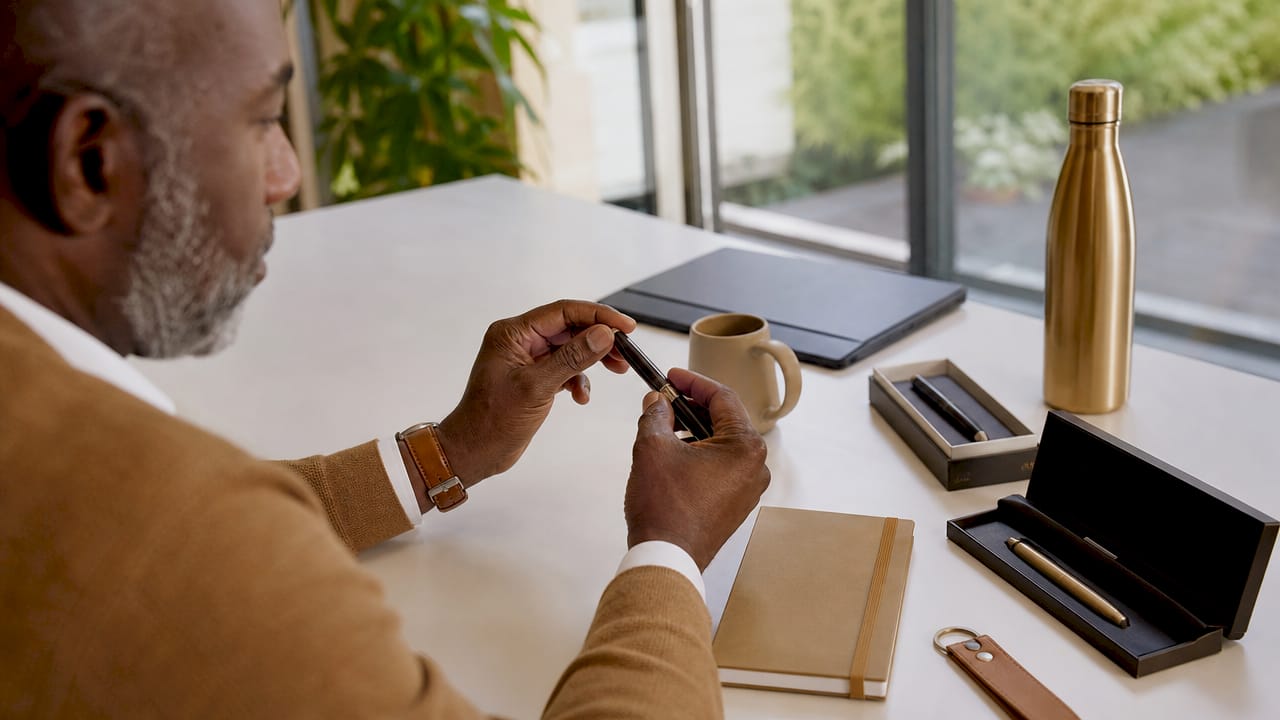
Brand compliance is the second criterion. Color, material and shape of the article must fit the corporate design. Corporate design as a system means: The brand becomes tangible through material, color and shape, not only through a logo print.
Segmentation according to the occasion and target group prevents malinvestment. A trade fair visitor needs something other than a long-time VIP customer. The purchase quantity should be derived for the target group, occasion and realistic demand. These figures show: Not every item fits every moment.
Article selection checklist:
- Is the item used at least once a week?
- Does the material meet the quality standards of the brand?
- Does the colour scheme fit exactly with the brand guidelines?
- Is the article suitable for the specific occasion (fair, VIP event, onboarding)?
- Is there a clear quantity strategy for every deployment moment?
Professional tip: Always order a sample before series production. Early sample control prevents production errors in printing, color fidelity and material and secures the delivery date.
2. How premium personalization increases brand impact
Premium promotional products achieve a 3- to 10-fold ROI compared to standard items. This difference is caused by higher acceptance by the recipient and longer service life. Once you have held a high-quality article in your hand, you combine the brand behind it with quality.
Success depends on three factors: brand awareness of the product used, material quality and the choice of finishing technology. Brands such as The North Face or Stanley have a high acceptance in Germany as premium promotional products. They work as promotional products because the recipient would appreciate the item even without a brand logo.
Discreet finishing is not a compromise, but a method. Overbranding, i.e. Too big or too dominant logo, reduces acceptance and seems intrusive. High-quality refinement significantly increases credibility and user acceptance.
“Quality and personalization are the main drivers of sustainable brand loyalty. Not the quantity and not the size of the logo decides the success of a promotional item."
Personalized giveaways trigger appreciation and trust in the B2B sector when quality, utility and subtle branding fit together. An article that bears the name of the recipient or is tuned to its profession produces an emotional reaction that a generic pen can never trigger.
What to consider when finishing:
- Embroidery is suitable for textiles with a high washing frequency.
- Laser engraving is durable and abrasion resistant for metal and glass.
- UV printing works well for flat surfaces, but is more sensitive to sunlight.
- The finishing technology must fit the usage situation, otherwise the brand image suffers from premature wear and tear.
3. Typical mistakes in the planning of promotional products
The most common mistake is the focus on quantity instead of quality. Many companies buy large quantities of cheap items because the unit price seems low. The result: the items are not used, the budget is gone and the brand has not gained any advantage.
- Too many articles, too little relevance. Those who distribute 5,000 ballpoint pens without a target group reference do not generate brand loyalty. Better: 500 high-quality items for the right target group at the right time.
- Missing release processes. Without a clear approval process between marketing, graphics and procurement, color deviations, false logos or delayed deliveries are created. Early coordination of all parties involved prevents these errors.
- Finishing without material testing. A printed logo on an item that is washed daily fades after a few weeks. This damages the brand image directly.
- No emotional speech. Promotional products that have no personal connection to the recipient act as a mandatory program. Hyperpersonalization with data and technology will become more important in 2026 than mass-produced goods for strong brand loyalty.
- Wrong timing. A promotional item that arrives after the fair has missed its moment. Timing and logistics decide on the success of the campaign. Late delivery can nullify the entire effect.
Professional tip: , before placing an order, determine in writing who releases the samples, who delivers the print data and by when the goods must be at the place of use. This simple step prevents most operational errors.
4. Strategically integrate promotional products into brand communication
Promotional products work the most when used at fixed contact points. These so-called moment chains define which article is handed over in the customer relationship at what time. Strategic planning along these points of contact makes promotional products a predictable brand tool instead of a one-time action.
The combination of giveaways and high-quality gifts is not a contradiction. Giveaways create range, premium items create depth. Those who plan both cover different phases of the customer relationship.
Digital integration increases measurability. QR codes on physical promotional products connect the analog touchpoint with digital campaigns. This makes it possible to measure how many recipients visited a landing page after receiving the article.
For planning, a Corporate Gifting Strategy, which clearly assigns events, target groups and budgets. Those who fix this strategy in writing avoid ad hoc decisions and ensure that every item fits the brand identity.
| Operational Moment | Article type | Target |
|---|---|---|
| First contact (fair) | Giveaways, functional | Attention, range |
| Offer presentation | High quality single gift | Trust, differentiation |
| Conclusion of contract | Personalized premium set | Appreciation, attachment |
| Anniversary / Thank you | Exclusive Award or Cup | Loyalty, emotional attachment |
| Onboarding staff | Personalized Welcome-Box | Belonging, motivation |
What a good moment chain strategy includes:
- Clear definition of all relevant contact points in the customer journey
- Set item categories and budgets per moment
- Procurement, personalization and handover responsibilities
- Measured variables, e.g. B. Scan rate on QR codes or repurchase rate after gift
Anyone who Custom awards as promotional product use, creates a lasting memory at key moments such as anniversaries or awards. These articles are often visible in the recipient’s office for years. This is a brand presence that no digital medium can replicate.
For companies that want to combine their brand communication with digital channels, it is worth looking at digital marketing agencies that have experience with integrating physical and digital touchpoints.
Important insights
Promotional products permanently strengthen the brand identity only when quality, personalization and a planned use work along fixed points of contact.
| Topic | Details |
|---|---|
| Selection criteria | Functionality and brand compliance are more important than unit price. |
| Premium Personalization | High-quality finishing and discreet branding increase acceptance and service life. |
| Error avoidance | Pattern control, clear release processes and proper timing prevent the most common errors. |
| Moment chains | Fixed contact points in the customer relationship make promotional products predictable and measurable. |
| Digital Integration | QR codes connect physical articles with digital campaigns and enable success measurement. |
High-quality promotional glass promotional products for strong brands
If you want to strengthen brand identity through promotional products, you need articles that are not thrown away. inCrystal has been producing individual glass trophies, awards and 3D crystals for over 18 years 3D laser subsurface engraving, which permanently immortalize brand messages in the glass.
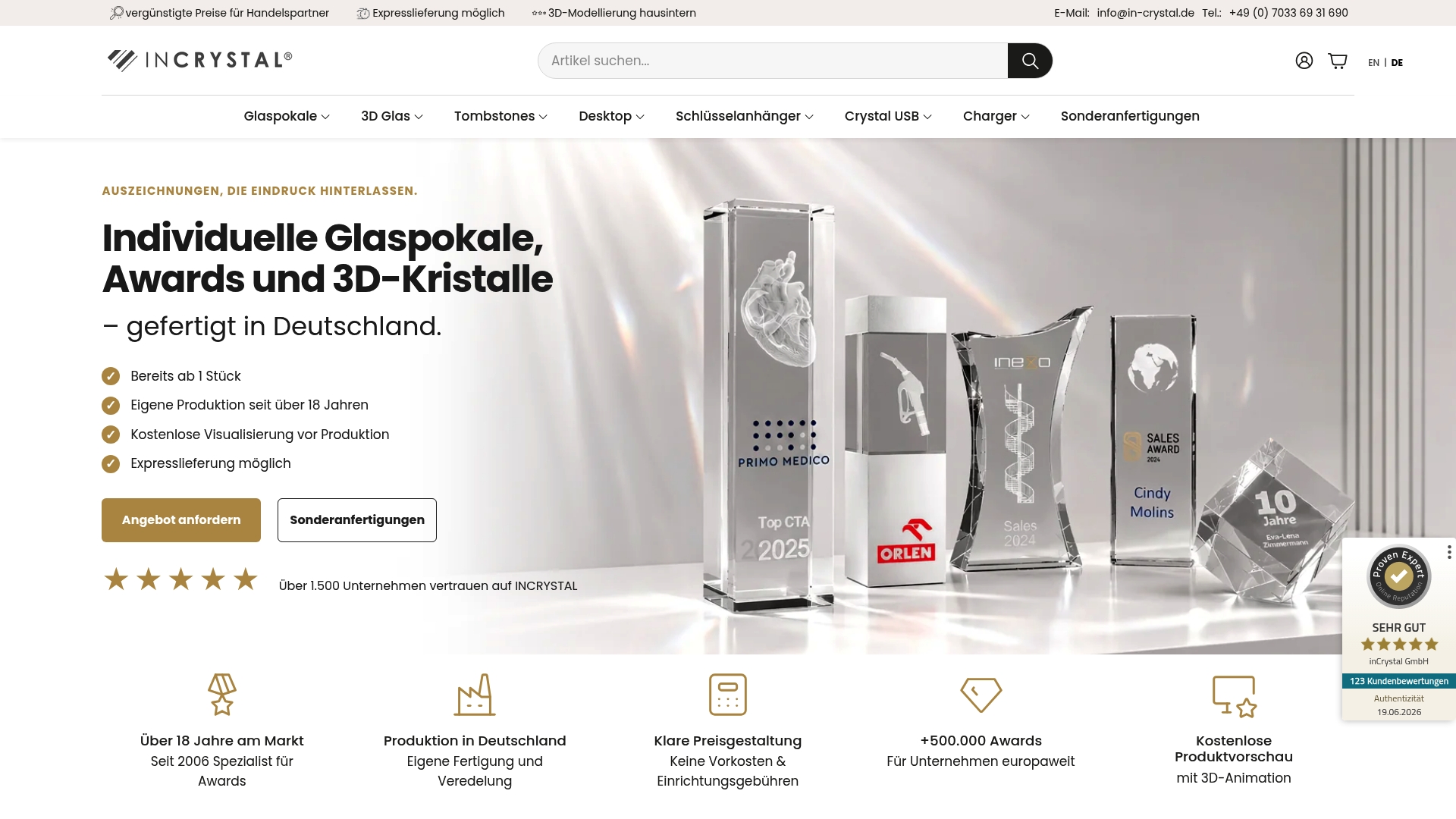
Each piece is modeled in-house. Customers will receive a free 3D preview before production. Express delivery is possible. The Glass cube with 3D subsurface engraving and Personalized glass power banks suitable for VIP gifts, awards and anniversaries. Request your free 3D preview on.
FAQ
What are the main criteria for good promotional products?
Functionality and brand compliance are the two key criteria. An article must be used in everyday life and fit the corporate design in color, material and shape.
How many promotional products should you order per operating moment?
Quantity planning should be derived from the target group, occasion and realistic needs. The amount depends on the occasion and the target group.
Why are premium promotional products more profitable than cheap giveaways?
Premium items achieve a 3- to 10-fold ROI over standard items because they are used longer and have a higher acceptance at the recipient.
How can promotional products be made digitally measurable?
QR codes on physical promotional products connect the analog touchpoint with digital campaigns. This makes it possible to measure how many recipients visited a landing page after receiving the article.
What is the most common mistake when using promotional products?
The most common mistake is the purchase of large quantities of cheap items without a target group reference. Quality and relevance for the recipient are more important than a low number of pieces.