




Posted by Andreas Vavelidis
on July 21, 2026

What is brand storytelling, and why does engraving make the difference?
Brand storytelling is the targeted storytelling of a brand message about emotions, values and attitude. No product list, no fact collection. A story that remains.
Every effective brand story carries three core elements:
- Purpose: Why does the brand exist? What drives them?
- Mission: What specifically does it do to fulfill this purpose?
- Values: How do you recognize them in everyday life?
A consistent brand story creates differentiation, even if products hardly differ. Trust is not created by arguments, but by recognition and emotional resonance.
And this is where engraving comes in. Stories are much better remembered than pure facts. Physical objects with engraved messages do just that: They translate an abstract brand story into something tangible that can be touched, retained and experienced daily. inCrystal has been implementing this principle in glass with 3D internal engravings for many years.
How do you develop your own brand story? Four Steps
1. Define Brand Purpose and Mission
Ask yourself a single question: why is your brand? ’s not “we sell X”, but what’s behind it. Write down the answer in two sentences. If this is difficult, the purpose is not yet clear enough.

2. Emotional core message formulating
From purpose and mission, a core message emerges that appeals to your audience emotionally. ’s not: “We offer high-quality products.” But: “We make performance visible.” The difference is whether the message triggers a feeling or describes only one trait.
3. Select Narrative Structure
The hero’s journey is the most famous format. Your client is the hero, your brand is the mentor. Alternatively, the 3-act model works: starting position, turning point, resolution. Both structures give the story an arc of tension that pays attention.
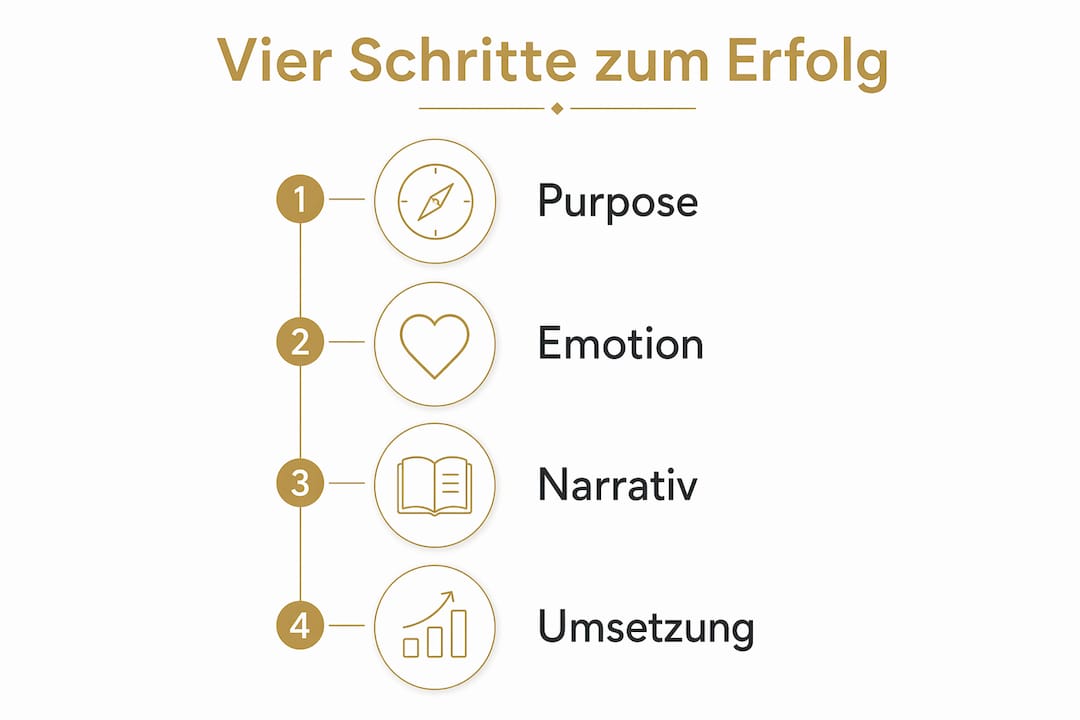
4. Implementation in communication tools, including engraving
A brand story needs carriers. Digital channels, packaging, promotional products. Engraved objects are particularly effective because they physically anchor the story. An engraved glass cube with your brand motto stays on the customer’s desk. Not a blog post.
Professional tip: Engage your target audience early. Talk to customers before you commit the story. Authentic brand stories do not arise in the conference room, but in dialogue. Consistency across all channels is then the second step, not the first.
What narrative structures are the strongest?
Neuropsychological findings show that stories activate more brain regions than facts. Emotional attachment through storytelling arises because the brain processes empathy and memory at the same time in narratives.
Three structures dominate in the brand context:
- Hero's Journey: Customer as a hero, brand as a mentor. Classic, because universally understandable.
- 3-act model: Situation, conflict, solution. Clear and direct, good for short formats.
- Before-After: Shows transformation. Particularly effective for products that produce visible changes.
Important: The brand does not act as a hero in these structures. She is the mentor who helps the client achieve their goal. E brands that put themselves at the center are losing emotional connection to the audience.
Emotional anchoring succeeds through repetition and consistency. Same message, on different channels, in different formats. And also physically, through engraved objects that make the story permanently visible.
Company History and Brand Story: What’s the Difference?
Many companies confuse both. That costs effect.
Company history:
- Facts about foundation, milestones, growth
- Orderly, chronologically
- Relevant for investors and journalists
- Emotionally unbinding for customers
Brand Story:
- Emotional narratives around values and vision
- Not chronological, but thematically
- Relevant for customers, partners, employees
- Creates identification, regardless of the year of foundation
E a company that was founded in 1987 doesn't have to put that in the foreground. What matters: What does it stand for today? What attitude does it take? A brand story can be strong even without a long history if it is clear and authentic.
Practically, this means: The company’s history belongs on the “About Us” page. The brand story belongs to every means of communication that customers touch. Also on engraved promotional products, awards and trophies. Precisely there, because they remain visible for a long time.
How does engraving make your brand story physically tangible?
Engraving is not a decorative agent. It is a physical anchor point for brand messages that builds trust in a digitally cluttered world because it is touchable.
Why this works:
- Haptics create memory.Obsective structures activate additional sensory channels. What you touch remains longer in memory than what you see.
- Longevity ensures effect. Laser engravings are resistant to abrasion and environmental influences. The message will be preserved for years.
- Material choice affects perception. Glass looks classy and timeless. Metal stands for durability. The choice of material is part of the story.
Best practice examples:
- Engraved glass cubes with company motto as customer gift
- Trophies with individual message for employee awards
- USB crystals with 3D subsurface engraving as a trade fair gift
The unpacking experience with an engraved product is a unique moment of customer loyalty. The recipient feels appreciation before he even uses the object.
Integration into customer communication: Engraved objects work most strongly when embedded in a context. A short map that explains what the engraved message means doubles the emotional impact. For sustainable brand visibility, the same principle applies: consistency across all points of contact.
Challenges and Solutions:
- Problem: Engraving is generic when the message is too general. Solution: Choose concrete, brand-typical formulations, not a “thank you for your loyalty”.
- Problem: Poor material quality harms brand perception. Solution: High-quality materials and tested engraving processes such as 3D laser engraving use.
- Problem: Engraving is isolated without a storytelling context. Solution:Embed object in all communication, with accompanying text, packaging and transfer moment.
inCrystal offers a free 3D visualization before production for all these points. So companies see the result before they order.
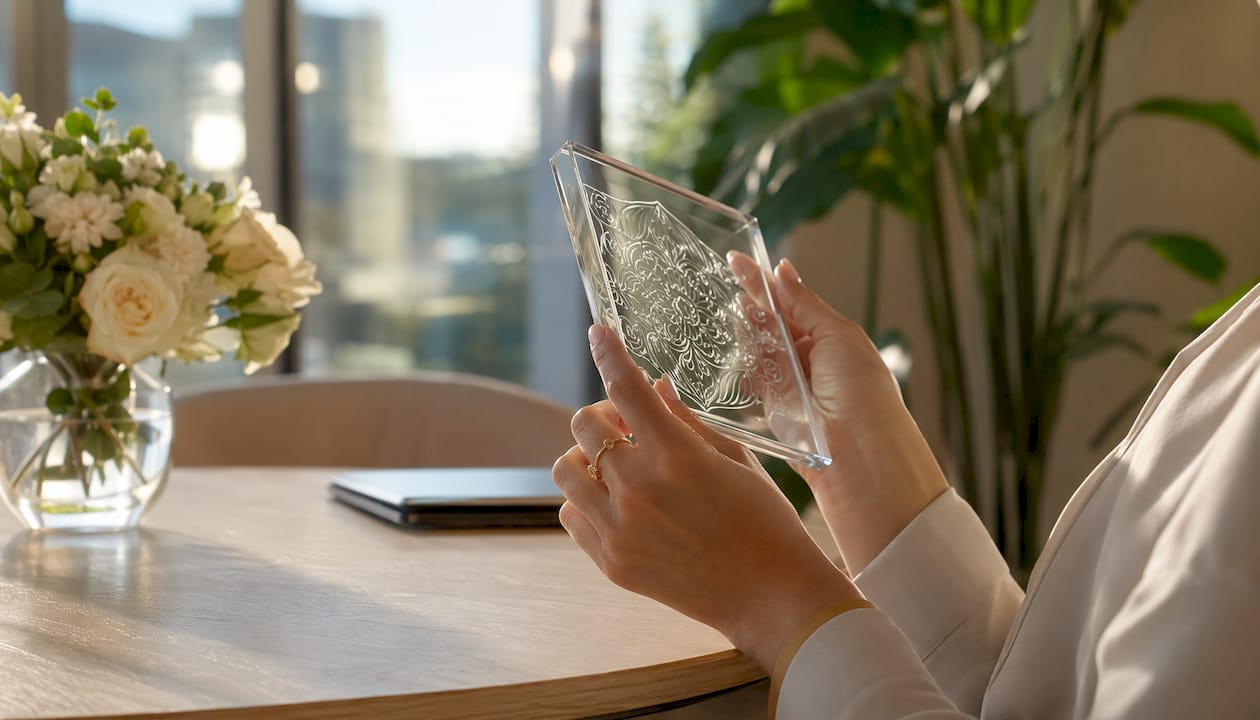
inCrystal: Perpetuating brand stories in the glass
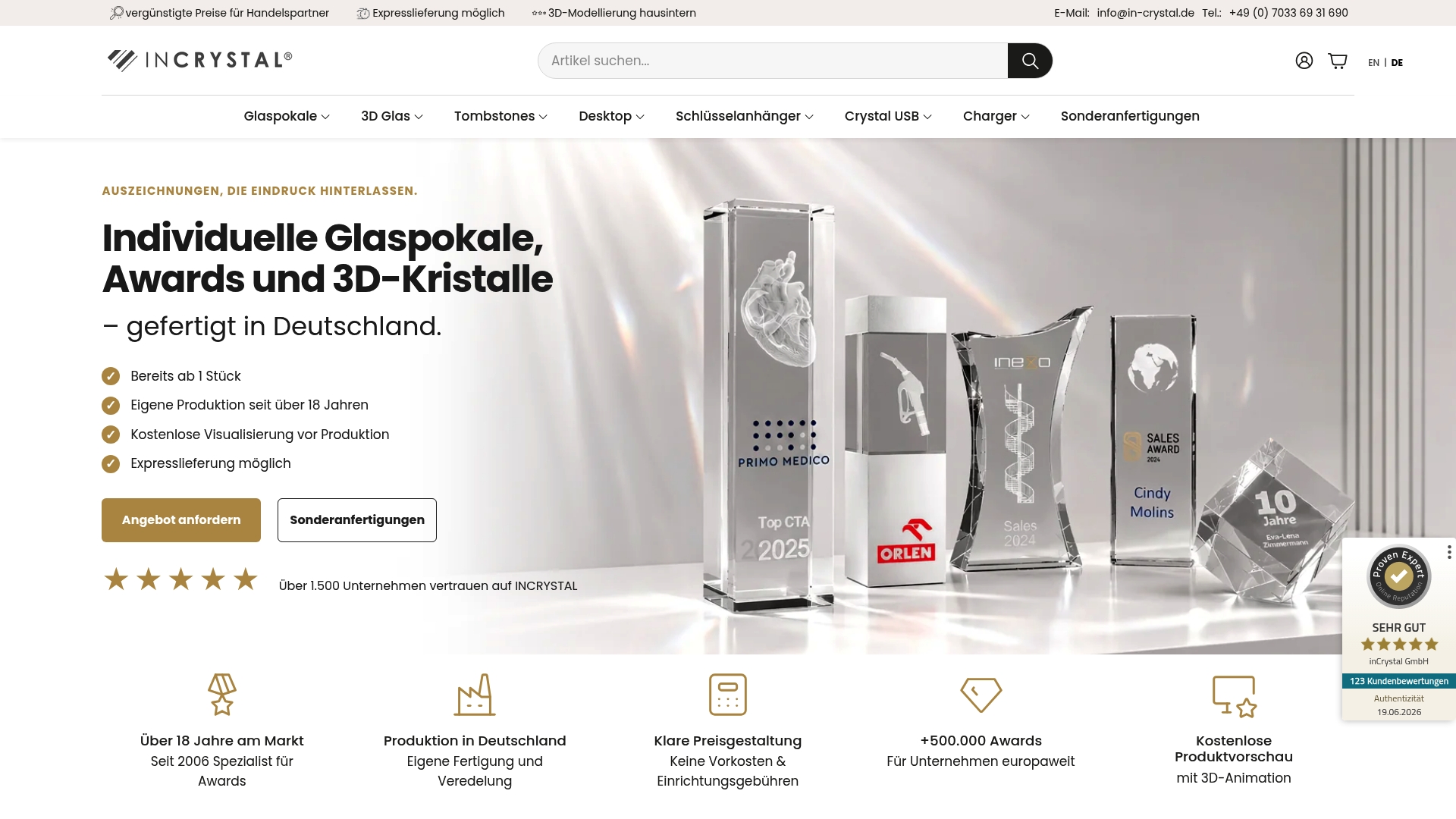
inCrystal has been ennobling individual glass trophies, awards and 3D crystals with subsurface engraving for over 18 years. Hundreds of companies use these objects to make their brand message physically tangible.
The offer includes express delivery, in-house 3D modeling and a free 3D preview before production. No generic promotional product. An object that carries your story.
Request a quote now and make your brand story tangible.
Important insights
Engraving transforms abstract brand stories into physical objects that touch customers daily and permanently remind of the brand.
| Topic | Details |
|---|---|
| Core of every brand story | Purpose, mission and values form the basis, without it any communication remains arbitrary. |
| E effect of memory of stories | Stories are much better remembered than pure facts, engraving reinforces this effect through haptics. |
| Engraving as a storytelling medium | Laser engravings are abrasion-resistant and durable, the brand message remains visible for years. |
| Company history vs. Brand Story | Company history provides facts, brand story creates emotional attachment, both perform different functions. |
| Integration into customer communication | Engraved objects look the strongest when they are connected to context, accompanying text and a clear transfer moment. |